Fine-Tuned Models and Hybrid RAG: Building Defensible AI Systems
Three key takeaways from this research
- Fine-tuning plus hybrid RAG creates defensible moats Either technique alone fails at scale. Combined, they compound over time through user data feedback loops, establishing 18-24 month replication barriers competitors cannot quickly breach.
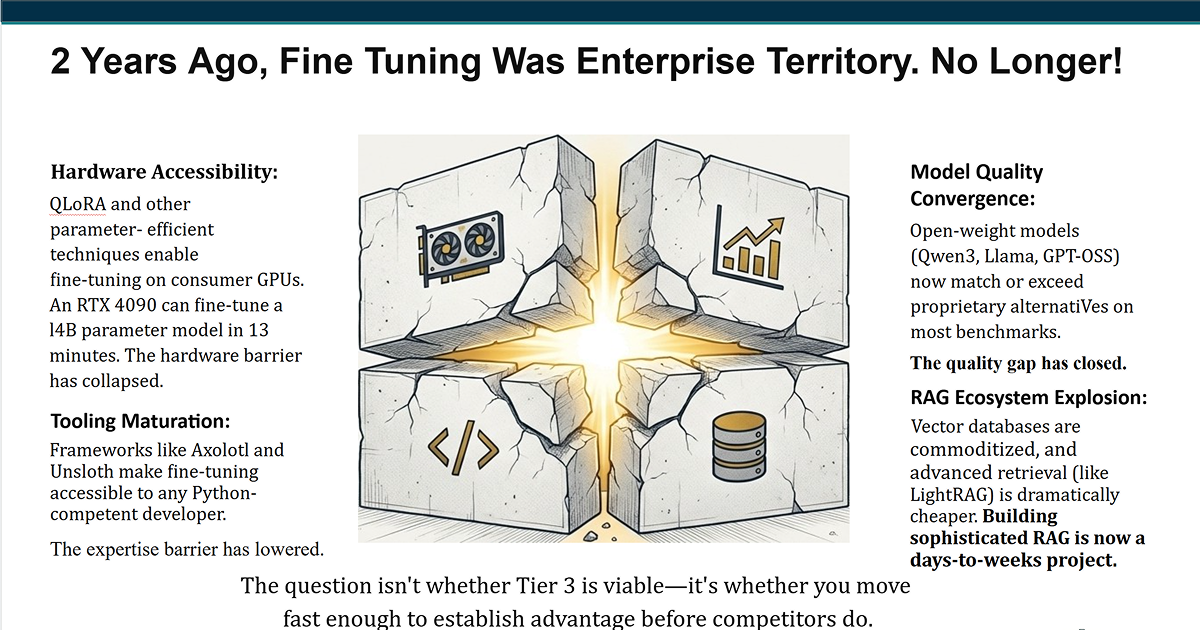
- Consumer hardware now enables fine-tuning validation in hours QLoRA on RTX 4090 fine-tunes 14B models in 13 minutes. Phase 0 validation costs under $50. The capability barrier has collapsed; execution speed determines advantage.
- Vector RAG handles 70-80% of queries; graph-enhanced handles the rest Start with vector search. Add LightRAG for relationship queries at 1% of GraphRAG cost. Reserve full GraphRAG only for high-value multi-hop analysis where accuracy ROI justifies indexing investment.
Discuss a related project
To scope and de-risk complex AI builds.
Read Executive Summary
Full paper with architecture breakdowns.

The Problem with API Wrappers
Every new AI app feels the same because most are built as API wrappers—essentially a user interface layered on top of commercial models like GPT or Claude. While they're incredibly fast to build, their competitive advantage is paper thin, and anyone could copy their core features in a single afternoon.
This market fatigue is real. When major incubators like Y Combinator stopped funding API wrappers entirely, it sent a clear signal that this business model is a dead end.
The Three-Tier AI Landscape
Tier One is like renting a furnished apartment—you get basics but can't change anything. This is your simple wrapper, with margins so thin you're lucky to break even.
Tier Two lets you redecorate by fine-tuning commercial models through their API, but you're still bound by the provider's rules and constraints.
Tier Three is building your own house from the ground up. You fine-tune open source models and host your own knowledge systems. This is where real defensibility lives, with margins exceeding 90%.
Rent vs. Own: The Fundamental Choice
Every AI business comes down to one critical decision: will you rent capabilities from a big provider, or build them yourself? Renting is fast but leaves you with razor-thin margins. Building is harder upfront but creates a lasting, profitable asset you completely control.
Pillar One: Building a Unique AI Personality
Simply relying on prompts doesn't work. A prompt is just a suggestion—the model's real personality is baked into its weights. After 15 conversation turns, even a brilliant Socratic coaching AI drifts back to generic helpful-assistant mode.
The solution is fine-tuning, which literally shapes how your AI thinks by changing its core brain. Until recently, this required massive server farms and teams of PhDs, making it accessible only to well-funded companies.
But that's changed dramatically. With new techniques, you can now fine-tune a powerful open source model in just 13 minutes on a regular gaming graphics card. Building a unique AI brain is no longer a multi-year investment—it's an afternoon experiment.
Pillar Two: Knowledge Through Retrieval-Augmented Generation
After crafting your custom brain, you need to give it a library of information. This is where Retrieval-Augmented Generation (RAG) comes in, letting your model look up facts on the fly like a person would.
Simple vector RAG is cheap and easy but struggles with complex questions. Graph RAG handles tricky relationships powerfully but is expensive. Light RAG offers practical middle ground with most of the power for a fraction of the cost.
The secret is that you don't have to choose just one. The most effective systems today are hybrids that intelligently combine different retrieval methods. A query router examines each question, sends it to the best search engine for the job, a re-ranker filters results, and finally your fine-tuned AI generates an accurate answer using perfectly curated context.
The Data Flywheel: Your Competitive Moat
Launch your model even if it isn't perfect. Real world usage with actual users generates incredibly valuable feedback—obvious signals like ratings and subtle signals from interaction patterns. Every user interaction becomes raw material for creating new training data that makes your AI smarter.
This creates a powerful self-reinforcing loop: a better model attracts more users, more users generate more data, more data makes the model even better. Your advantage compounds rapidly and becomes almost impossible for competitors to replicate.
A new competitor can copy your idea, but they can't replicate 18 to 24 months of user data that makes your AI uniquely intelligent. That's a real, defensible moat.
The Business Transformation
This isn't just a technical advantage—it completely transforms your business economics. Instead of struggling with a flimsy 15% margin, you operate on a robust 95% margin. You can be profitable with just a handful of customers instead of needing thousands to cover API bills.
This is the difference between being dependent on venture capital and building a sustainable, profitable business from day one.
The Future of AI Innovation
The next wave of AI innovation comes down to one fundamental question: are we building new capabilities and intelligence, or simply renting it? The answer determines who builds the truly transformative AI companies of the next generation.