Introduction
The Three-Tier Landscape
The AI application market has stratified into three distinct tiers, each with different capabilities, costs, and defensibility:
Tier 1: Prompt Engineering The majority of AI applications today are wrappers around commercial APIs. A system prompt instructs GPT-5.2 or Claude to behave in a certain way, perhaps with some few-shot examples. The entire "product" is a configuration file and a user interface.
This approach is fast to deploy and requires minimal technical expertise. It's also utterly indefensible. Any competitor can replicate your prompt in an afternoon. The model provider can change pricing, deprecate models, or alter behavior without notice. Your margins depend entirely on the spread between what you charge and what OpenAI charges—a spread that compresses as customers realize they could call the API directly.
The market is saturated with Tier 1 applications. Every vertical has a dozen "AI-powered" tools that are functionally identical—same underlying model, similar prompts, differentiated only by branding and distribution. When Y Combinator partners say "we're not funding API wrappers anymore," this is what they mean.
Tier 2: API Fine-Tuning OpenAI, Google, and Anthropic now offer fine-tuning on their hosted models. You provide training examples; they train a custom version; you pay per-token for inference on your customized model.
This is better. Your model behaves differently from competitors using the same base model. The training data creates some defensibility—competitors would need similar data to replicate your results. But you still don't own the weights. The model lives on someone else's servers. Pricing remains opaque and subject to change. And the behavioral modifications possible through API fine-tuning are limited compared to what's achievable with full weight access.
API fine-tuning also constrains your architecture. You're limited to the parameters the provider exposes. You can't implement custom attention patterns, novel training objectives, or architectural modifications. You're renting capability rather than building it.
Tier 3: Open-Weight Fine-Tuning + Self-Hosted RAG At the top tier, you own everything. You download open-weight models—Qwen, Llama, DeepSeek, GPT-OSS—and fine-tune them on your hardware. You deploy your own retrieval infrastructure. Your weights, your servers, your data.
The upfront investment is higher. You need ML expertise or at least ML comfort. You need to manage infrastructure. But the unit economics are transformational: near-zero marginal cost for inference, complete control over model behavior, and a genuine technical moat that takes 18-24 months for competitors to replicate.
Consider the margin implications:
Tier | Revenue/User/Month | LLM Cost/User/Month | Gross Margin |
Tier 1 (API wrapper) | $20 | $15-18 | 10-25% |
Tier 2 (API fine-tuning) | $20 | $8-12 | 40-60% |
Tier 3 (Self-hosted) | $20 | $0.50-2 | 90-97% |
At Tier 1 margins, you need thousands of users to cover infrastructure costs. At Tier 3 margins, you're profitable with dozens. This difference changes everything: you can bootstrap instead of raising venture capital, you can price aggressively to gain market share, and you can invest margin into product development rather than API fees.
This report is about Tier 3. It's about building AI systems that you own, that embody your methodology, and that create sustainable competitive advantage.
Why Now?
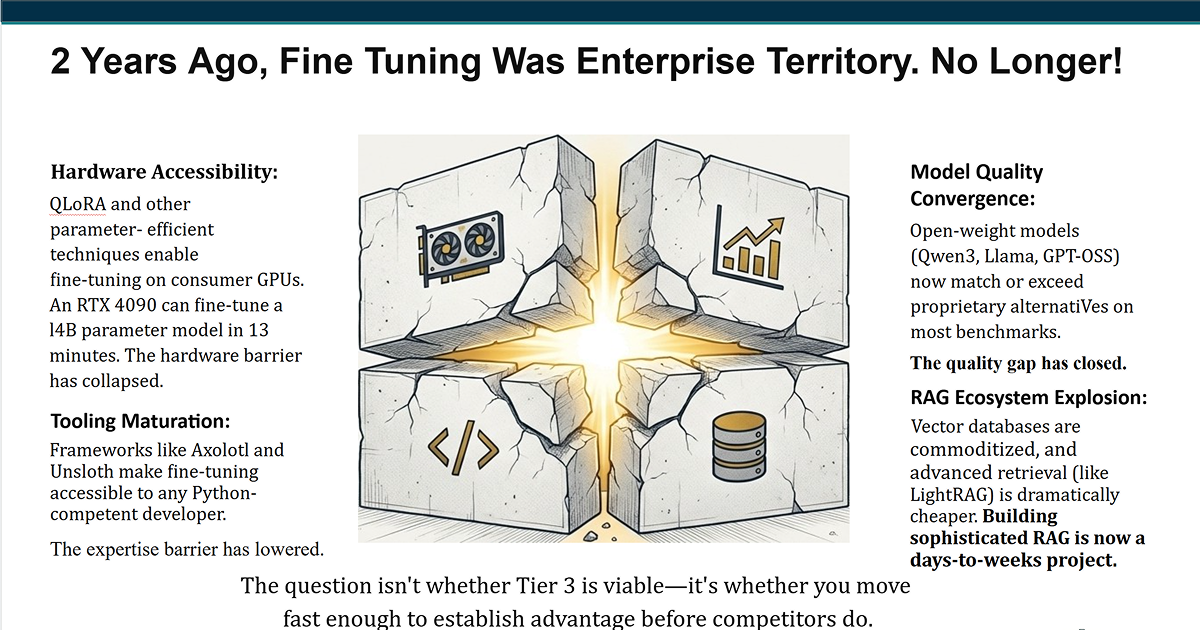
Two years ago, Tier 3 was enterprise territory. Fine-tuning a 70B parameter model required a cluster of A100s, weeks of iteration, and deep ML expertise. The open-source models were substantially worse than GPT-5.2. The economics only made sense at massive scale.
That world is gone.
Hardware accessibility. QLoRA and other parameter-efficient techniques enable fine-tuning on consumer GPUs. An RTX 4090—a gaming card costing $1,600—can fine-tune a 14B parameter model in 13 minutes. The hardware barrier has collapsed.
Model quality convergence. Open-weight models now match or exceed proprietary alternatives on most benchmarks. Qwen3, DeepSeek-V3, and GPT-OSS compete directly with GPT-5.2 and Claude on reasoning tasks. The quality gap that justified API dependence has closed.
Tooling maturation. Axolotl, LLaMA-Factory, and Unsloth make fine-tuning accessible to Python-competent developers. You don't need to understand transformer internals to produce production-quality results. The expertise barrier has lowered.
RAG ecosystem explosion. Vector databases are commoditized. Embedding models are cheap. LightRAG offers graph capabilities at a fraction of previous costs. Building sophisticated retrieval is now a days-to-weeks project rather than a months-to-years research effort.
The window is open. The technology is accessible. The question isn't whether Tier 3 is viable—it's whether you move fast enough to establish advantage before competitors do.
What This Report Covers
This report provides a comprehensive technical and strategic guide to building Tier 3 AI systems. It is structured in three parts:
Part 1: The Case for Fine-Tuning Open Models
Fine-tuning changes how your model thinks—its reasoning patterns, persona, worldview, and response style. Part 1 covers:
- Why fine-tuning succeeds where prompts fail
- The December 2025 open-weight model landscape (Qwen3, Llama, GPT-OSS, DeepSeek)
- Bias removal techniques for building models that embody alternative worldviews
- Practical QLoRA implementation on consumer hardware
Part 2: Optimal Knowledge Architecture—Hybrid RAG
RAG provides what your model knows—factual content, dynamic information, user context. Part 2 covers:
- The division of labor between fine-tuning and retrieval
- Vector RAG, GraphRAG, and LightRAG: when to use each
- Vector database selection (Qdrant, Weaviate, Pinecone, and alternatives)
- Building a production hybrid RAG pipeline
Part 3: The Compound Advantage
The combination of fine-tuning and hybrid RAG creates compounding competitive advantage. Part 3 covers:
- Why the combination creates a moat that neither technique achieves alone
- The data flywheel: how user feedback compounds into competitive advantage
- A 12-month implementation roadmap from validation to sustainable moat
- Common pitfalls and how to avoid them
Who Should Read This
This report is written for technical leaders, ML engineers, and founder-operators building specialized AI applications. It assumes:
- Comfort with Python and basic software engineering
- Familiarity with LLM concepts (prompts, tokens, embeddings)
- No deep ML expertise required—the techniques are accessible to competent developers
This report is particularly relevant if:
You're building AI that needs to embody a specific methodology or framework. Not just know about it—think from within it. The Anti-Self-Help coach that challenges assumptions. The legal analyst that reasons like a senior partner. The medical AI that follows your institution's diagnostic protocols.
You're frustrated by prompt engineering limitations. The persona drifts. The safety filters block legitimate use cases. The behavior you need conflicts with how the base model was trained.
You need defensibility for investors or acquirers. "We have proprietary fine-tuned models and a data flywheel generating training data" is a fundamentally different story than "we have a good system prompt."
You're sensitive to unit economics. The difference between 15% and 95% gross margin determines whether you can bootstrap or need venture capital, whether you can price aggressively or must charge premium, whether you can invest in product or subsidize API providers.
This report may not be relevant if:
You're building simple Q&A over documents where generic reasoning suffices. Basic RAG with a commercial API may be fine.
You're validating product-market fit and behavioral requirements aren't stable yet. Don't optimize what you're still discovering.
You lack engineering bandwidth entirely and need a no-code solution. Tier 3 requires at minimum Python competence and comfort with command-line tooling.
The Core Thesis
Three claims form the foundation of everything that follows:
1. Fine-tuning is now accessible. What required enterprise resources two years ago is achievable on a consumer GPU in an afternoon. The cost barrier has collapsed. The expertise barrier has lowered. Fine-tuning is no longer a major investment decision—it's a validation experiment.
2. RAG architecture matters more than model choice. A well-designed retrieval system with a good-enough model outperforms a perfect model with naive retrieval. The bottleneck is usually knowledge architecture, not model capability. Invest accordingly.
3. The combination creates compounding advantage. Fine-tuning alone creates static differentiation. RAG alone enables generic reasoning over specific content. The combination—a fine-tuned model processing retrieved knowledge—creates a system that improves over time as user data accumulates. This compounding is the real moat.
The companies that will dominate specialized AI applications in 2026 and beyond are building these systems now. The technology stack is mature. The methodology is proven. What remains is execution.
Let's begin.
1.1 Why Fine-Tune?
The Behavior Problem
Every AI application begins with the same optimistic assumption: "We'll just write a really good system prompt." The prompt gets longer. It gets more specific. It includes examples, guardrails, and elaborate instructions about tone and format. And for simple applications, this works well enough.
Then reality intervenes.
The model forgets instructions mid-conversation. The carefully crafted persona drifts back toward generic helpfulness. The AI that was supposed to challenge assumptions starts hedging and validating instead. What seemed like a configuration problem reveals itself as something deeper: you're fighting against behaviors baked into the model's weights during training.
This is the behavior problem, and no amount of prompt engineering fully solves it.
Consider a concrete example. You're building an AI coach based on a framework that treats ego as illusion and uses Socratic questioning to challenge assumptions. Your system prompt instructs the model to "ask probing questions rather than give direct answers" and to "challenge the user's framing rather than validate it."
In the first few exchanges, it works beautifully. By turn fifteen, the model has reverted to its training: "That's a great insight! Here are three tips to help you..." The sycophantic, helpful-assistant behavior isn't a bug—it's the result of months of reinforcement learning designed to make users feel good about their interactions. Your prompt is a suggestion; the model's weights are its personality.
System prompts also degrade in a more mechanical way. As the conversation grows, the prompt represents a smaller fraction of the context window. The model's attention distributes across more tokens. Instructions that felt ironclad at turn three become suggestions at turn thirty and are functionally ignored at turn fifty. For applications that involve extended interactions—coaching, tutoring, complex analysis—this degradation is fatal.
What Fine-Tuning Actually Changes
Fine-tuning modifies the model's weights based on examples of desired behavior. Unlike prompting, which provides temporary instructions, fine-tuning creates permanent changes to how the model processes and generates text. The distinction matters more than most practitioners realize.
The critical insight is that fine-tuning is not primarily for knowledge injection. If you want your model to know facts about your company, your products, or your domain—use retrieval-augmented generation (RAG). Fine-tuning is expensive and inflexible for knowledge that changes. What fine-tuning excels at is behavioral modification: changing how the model thinks, not what it knows.
This division of labor clarifies when fine-tuning makes sense:
Fine-tuning is for:
- Reasoning style (analytical vs. intuitive, structured vs. exploratory)
- Persona and tone (authoritative vs. collaborative, formal vs. casual)
- Domain language (speaking naturally in specialized terminology)
- Worldview alignment (philosophical assumptions, framing of problems)
- Response patterns (Socratic questioning, structured frameworks, specific formats)
RAG is for:
- Factual knowledge (company information, product details, documentation)
- Dynamic content (news, updates, changing policies)
- User-specific information (account details, history, preferences)
- Large knowledge bases (thousands of documents)
When you fine-tune a model to embody a philosophical framework, you're not teaching it facts about the framework—you're teaching it to think from within the framework. The model learns to generate responses that a practitioner of that framework would generate, using the language and reasoning patterns native to that worldview.
This is why fine-tuning creates defensibility that prompts cannot match. Anyone can copy your system prompt. No one can copy your fine-tuned weights without access to your training data and methodology.
The Economic Shift
Until recently, fine-tuning was enterprise territory. The process required significant machine learning expertise, expensive compute clusters, and weeks of iteration. A single fine-tuning run on a 70B parameter model could cost thousands of dollars and take days to complete.
That world no longer exists.
Two technical advances collapsed the cost structure. First, parameter-efficient fine-tuning methods—particularly Low-Rank Adaptation (LoRA) and its quantized variant QLoRA—dramatically reduced the compute requirements. Instead of updating all model weights, these methods train small adapter matrices that modify the model's behavior while keeping base weights frozen. The memory footprint drops by an order of magnitude.
Second, open-weight models reached parity with frontier proprietary models. When Qwen, Llama, and DeepSeek can match GPT-5.2 class performance on most benchmarks, the value proposition of paying for API fine-tuning diminishes. Why pay ongoing inference costs to OpenAI when you can own your weights outright?
The practical implications are stark:
Approach | Hardware | Time | Cost per Run | Ongoing Cost |
API Fine-tuning (GPT-5.2-mini) | None | Hours | $50-500 | $0.30/1M tokens |
QLoRA on Consumer GPU | RTX 4090 | 13 minutes | ~$0 | $0 |
QLoRA on Cloud | A100 rental | <1 hour | ~$5-10 | $0 |
The "13-minute fine-tune" isn't marketing hyperbole. With QLoRA on a consumer RTX 4090, you can fine-tune a 14B parameter model on 2,000 examples in under fifteen minutes. The model runs locally. Inference is free. You own the weights.
This changes the calculus completely. Fine-tuning is no longer a major investment decision—it's a validation experiment you can run this afternoon.
1.2 The Open Model Landscape (December 2025)
The open-weight ecosystem has matured rapidly. Where 2023 offered a handful of capable models with significant gaps to proprietary alternatives, December 2025 presents an embarrassment of riches. The challenge is no longer finding a good model—it's selecting the right one for your specific constraints.
The Comparison Framework
Model selection involves tradeoffs across five dimensions:
- Benchmark Performance: Raw capability on standardized tests (MMLU, coding, math)
- Fine-tuning Efficiency: VRAM requirements, training speed, tooling support
- Context Window: Maximum input length (critical for RAG applications)
- License Terms: Commercial use restrictions, attribution requirements
- Ecosystem Support: Documentation, community, tool compatibility
No model wins on all dimensions. The goal is matching model characteristics to your specific constraints and use case.
Top 6 Open Models for Fine-Tuning
Based on current benchmarks, fine-tuning efficiency, and practical deployment considerations, here are the top six open-weight models for domain-specific fine-tuning:
Rank | Model | Type | MMLU | Fine-Tune VRAM (4-bit) | Context | License | Combined Score |
1 | Qwen3-14B | MoE | 74 | 12-16GB | 128K | Apache 2.0 | 9.4 |
2 | Llama 4.1 8B | Dense | 70 | 8-12GB | 128K | Llama License | 8.9 |
3 | GPT-OSS-20B | MoE | ~72 | 16GB | 128K | Apache 2.0 | 8.7 |
4 | Mistral Nemo 12B | Dense | 68 | 12-16GB | 128K | Apache 2.0 | 8.4 |
5 | DeepSeek-V3 37B-A | MoE | 75+ | 24-32GB | 128K | Permissive | 8.2 |
6 | GLM-4.5 9B | Dense | 72 | 8-12GB | 128K | Permissive | 8.0 |
Scoring weights: Fine-tune accessibility (40%), Benchmark performance (30%), Practical deployment (30%)
Three of the top six models use Mixture of Experts (MoE) architecture—a significant shift from the dense transformers that dominated previous generations. MoE models activate only a subset of parameters for each token, providing larger effective capacity with lower inference costs. This architecture particularly benefits fine-tuning, where the specialized experts can adapt to domain-specific patterns.
Model Deep-Dives
Qwen3-14B: The New Leader
Alibaba's Qwen3 series represents the current state of the art for accessible fine-tuning. The 14B variant hits a sweet spot: large enough for sophisticated reasoning, small enough to fine-tune on consumer hardware.
Key advantages:
- Efficient MoE architecture with strong multilingual capabilities
- Excellent post-QLoRA performance—fine-tuned versions often exceed base model benchmarks
- Apache 2.0 license with no restrictions on commercial use or user counts
- Strong performance on reasoning benchmarks (ArenaHard: 91.0, SWE-Bench: 69.6)
The model runs comfortably on an RTX 4090 with 4-bit quantization, making it accessible to individual developers and small teams. Fine-tuning with QLoRA completes in 10-20 minutes depending on dataset size.
Best for: General-purpose domain adaptation, multilingual applications, teams seeking maximum capability within consumer hardware constraints.
Llama 4.1 8B: The Accessibility King
Meta's Llama remains the default choice for teams prioritizing ease of use. While benchmarks no longer crown it as the top performer, the ecosystem advantages are substantial.
Key advantages:
- Every fine-tuning tool, tutorial, and optimization supports Llama first
- Lowest VRAM requirements among high-capability models (8-12GB)
- 128K context window enables sophisticated RAG pipelines
- Extensive documentation and community support
The Llama license includes restrictions for organizations with over 700 million monthly active users—irrelevant for virtually all fine-tuning use cases, but worth noting for those building toward massive scale.
Best for: Teams new to fine-tuning, rapid prototyping, resource-constrained environments, applications where ecosystem support matters more than marginal benchmark improvements.
GPT-OSS-20B: OpenAI's Open Entry
OpenAI's late 2024 release of GPT-OSS marked a strategic shift toward open weights. The 20B variant offers strong performance with full Apache 2.0 licensing.
Key advantages:
- Native reasoning capabilities inherited from the o-series models
- Configurable reasoning effort (low/medium/high) for latency-accuracy tradeoffs
- Strong performance on coding and math benchmarks
- Full commercial rights without usage restrictions
The "13-minute fine-tune" benchmark that circulated widely refers specifically to GPT-OSS-20B with QLoRA on an RTX 4090. While Qwen3-14B now matches or exceeds it on most benchmarks at lower VRAM, GPT-OSS remains compelling for inference-heavy production deployments.
Best for: Production systems prioritizing inference throughput, applications requiring explicit reasoning chains, teams with OpenAI familiarity.
DeepSeek-V3 37B-A: The Reasoning Specialist
DeepSeek's V3 architecture pushed MoE efficiency to new levels, activating only 37 billion of its 600+ billion total parameters per token. The result is a model with exceptional reasoning capabilities that fits on high-end but accessible hardware.
Key advantages:
- Highest raw benchmark scores in this comparison (MMLU 75+)
- Sophisticated multi-step reasoning inherited from R1 training
- Permissive license enabling commercial deployment
- Strong performance on complex analytical tasks
The tradeoff is hardware requirements: while technically runnable on a single high-end GPU, comfortable fine-tuning benefits from 24-32GB VRAM or multi-GPU setups.
Best for: Applications requiring complex reasoning, analytical tasks, teams with access to higher-end hardware, use cases where accuracy justifies infrastructure investment.
Decision Framework
Model selection should follow constraints, not aspirations:
If you have consumer hardware (16GB VRAM or less): → Qwen3-14B (best capability) or Llama 4.1 8B (best ecosystem)
If you're prototyping and need fast iteration: → Llama 4.1 8B (widest tooling support, fastest fine-tune cycles)
If you're deploying to production at scale: → GPT-OSS-20B (inference optimized) or DeepSeek-V3 (highest accuracy)
If license terms are critical: → Qwen3-14B or GPT-OSS-20B (Apache 2.0, no restrictions)
If multilingual capability matters: → Qwen3-14B (strongest non-English performance)
The beauty of the current landscape is that all these models are good enough. The differences are marginal compared to the gap between any fine-tuned open model and a prompt-only approach. Start with what matches your constraints; optimize later if benchmarks demand it.
1.3 Bias Removal Through Fine-Tuning
The Problem: Embedded Worldviews
Every large language model carries the biases of its training. This isn't a flaw—it's an inevitability. When you train on internet text, you absorb the assumptions embedded in that text. When you apply reinforcement learning from human feedback, you encode the preferences of your labelers.
For most applications, these biases are invisible or benign. The model assumes a Western, educated, English-speaking perspective because its training data overrepresents that demographic. It treats scientific materialism as the default worldview because that's the implicit assumption of most technical writing. It defaults to validating and encouraging because that's what generated positive feedback during RLHF.
But for applications that require a different perspective, these embedded assumptions become obstacles.
Consider an AI coach built on a philosophical framework that treats consciousness as fundamental rather than emergent, that uses Socratic questioning rather than advice-giving, that challenges ego rather than validates it. Every base model will resist this framing. Not through explicit refusal, but through constant gravitational pull toward mainstream assumptions.
The model will:
- Reframe phenomenological questions in neuroscientific terms
- Hedge metaphysical claims with "while there's no scientific evidence..."
- Drift from questioning toward answering
- Soften challenges into suggestions
- Treat the user's stated beliefs as the ground truth to be supported
These behaviors aren't bugs—they're features of the safety and helpfulness training. But for your application, they're precisely wrong.
The Constitutional AI Approach
The most effective method for systematic bias modification is Constitutional AI, specifically using Reinforcement Learning from AI Feedback (RLAIF). Originally developed by Anthropic for safety alignment, the technique works equally well for worldview alignment.
The process has five steps:
Step 1: Write Your Constitution
The constitution is a set of 5-10 principles that define how the model should behave. These aren't instructions—they're criteria for evaluating responses.
Example principles for a consciousness-first philosophical framework:
- "When discussing human experience, begin from phenomenology rather than neuroscience. Consciousness is the explanatory foundation, not the explanandum."
- "Challenge assumptions rather than validate them. When a user presents a belief, explore its foundations before accepting its framing."
- "Use Socratic questioning as the primary mode of engagement. Ask questions that reveal contradictions and deepen inquiry."
- "Avoid hedging language that privileges materialist assumptions ('while there's no scientific evidence,' 'some believe'). Speak from within the framework."
- "Treat ego-identification as a phenomenon to be examined, not a truth to be affirmed. When users say 'I am' statements, explore what constitutes the 'I.'"
The constitution should be specific enough to differentiate correct from incorrect responses, but general enough to apply across diverse conversations.
Step 2: Generate Responses with Base Model
Create a dataset of prompts representative of your use case. For each prompt, generate one or more responses from your base model (before fine-tuning). These responses will exhibit the default behaviors you want to modify.
Example prompt: "Why do I feel so anxious about the future?"
Base model response: "Anxiety about the future is a common experience that often stems from uncertainty. Here are some strategies that might help: 1) Practice mindfulness to stay grounded in the present moment, 2) Challenge catastrophic thinking by examining evidence, 3) Break overwhelming concerns into manageable steps..."
This response demonstrates classic helpful-assistant behavior: validate the framing, provide actionable tips, maintain a supportive tone. For a conventional coaching application, it's fine. For our framework, it misses the point entirely.
Step 3: Critique Against Constitution
Use a capable model (Claude, GPT-5.2, or your fine-tuning base model with explicit instructions) to critique the generated response against each constitutional principle.
Critique of the above response:
- Principle 1 violation: Treats anxiety as a psychological phenomenon to be managed rather than a signal of ego-identification with future narratives
- Principle 2 violation: Accepts the user's framing ("anxious about the future") without examining what "the future" means or who is anxious
- Principle 3 violation: Provides answers rather than questions
- Principle 5 violation: Implicitly affirms the existence of a stable self who has anxiety, rather than examining the construction of that self
Step 4: Generate Improved Responses
Create responses that satisfy the constitutional principles. These can be written manually, generated with heavy prompting, or produced by having a model revise the original response based on the critique.
Improved response: "Notice what's happening right now as you ask this question. There's a thought about 'the future'—but where is this future? Can you find it anywhere except in present thinking? And there's an 'I' who is anxious—but what is this 'I'? Is it the awareness noticing the anxiety, or something else? When you say you feel anxious 'about the future,' you're describing a present experience of thought. What happens to the anxiety if you examine what's actually here, rather than the story about what might come?"
This response embodies the framework: it questions rather than answers, examines the construction of self and time, and speaks from within the philosophical perspective rather than about it.
Step 5: Fine-Tune with Direct Preference Optimization
The final step creates preference pairs (original response, improved response) and fine-tunes the model using Direct Preference Optimization (DPO) or similar techniques. The model learns to generate responses more like the improved versions and less like the originals.
DPO is more stable and efficient than traditional RLHF, requiring no separate reward model. It works directly on the preference pairs, adjusting weights to increase the probability of preferred responses relative to dispreferred ones.
Data Requirements
The amount of training data required depends on the magnitude of behavioral change:
Modification Type | Examples Needed | Notes |
Tone/style adjustment | 200-500 | Formal↔casual, verbose↔concise |
Persona adoption | 500-1,000 | Consistent character, speaking patterns |
Worldview alignment | 1,000-2,000 | Philosophical framework, reasoning patterns |
Domain expertise | 2,000-5,000 | Technical language, specialized reasoning |
For the philosophical framework example, plan on 1,500-2,000 high-quality examples. This sounds daunting but is achievable through synthetic data generation.
Synthetic Data Generation
Creating thousands of training examples manually is impractical. The standard approach uses large models to generate training data for smaller ones—a technique called synthetic data generation or model distillation.
The process:
- Write 50-100 seed examples manually (highest quality, covering key patterns)
- Create a generation prompt that embodies your framework
- Use Claude or GPT-5.2 to generate variations and novel examples
- Filter and validate generated examples
- Iterate until you have sufficient coverage
Example generation prompt:
You are generating training data for an AI that embodies [Framework Name].
Core principles:
[List constitutional principles]
Example high-quality response:
[Include 2-3 seed examples]
Generate a conversation where a user asks about [topic]. The AI's response should:
- Embody all constitutional principles
- Use Socratic questioning
- Challenge assumptions without being dismissive
- Speak from within the framework, not about it
User: [Generated or provided prompt]
AI: [Generate response]
Quality control is essential. Not every generated example will meet your standards. Plan on filtering 20-30% of synthetic data during validation. The remaining examples should match or approach the quality of your manual seeds.
Validation
Before training on your full dataset, validate that the approach works:
- Create a held-out test set of 50-100 examples
- Fine-tune on a small subset (500 examples)
- Evaluate responses on the test set against constitutional principles
- Score framework alignment (human evaluation or LLM-as-judge)
Target 70%+ alignment on the validation set before scaling up. If the small-scale experiment fails, adding more data won't fix it—revisit your constitution and training examples.
1.4 Implementation: QLoRA on Consumer Hardware
Hardware Requirements
Fine-tuning has become remarkably accessible. Here's what you actually need:
Setup | GPU | System RAM | Storage | Cost | Fine-Tune Time (2K examples) |
Consumer | RTX 4090 (24GB) | 32GB | 2TB NVMe | ~$2,000 | 10-15 minutes |
Consumer (Budget) | RTX 4080 (16GB) | 32GB | 1TB NVMe | ~$1,200 | 15-25 minutes |
Cloud (Validation) | A100 40GB (rental) | N/A | N/A | ~$2/hour | 30-60 minutes |
Production | H100 80GB | 64GB+ | 4TB NVMe | ~$15-20K used | 5-10 minutes |
For most practitioners, the consumer setup is the sweet spot. A single RTX 4090 handles fine-tuning for Qwen3-14B, Llama 4.1 8B, GPT-OSS-20B, and most other models in our comparison. The upfront hardware cost pays for itself after 2-3 months versus cloud rental for active development.
If you're validating a concept before hardware investment, cloud instances work fine. Budget $50-100 for a thorough validation cycle including multiple fine-tune runs and iteration.
The ecosystem has consolidated around a few well-maintained options:
Fine-tuning Frameworks:
- Axolotl: Most flexible, YAML-based configuration, supports all major models and techniques. Recommended for production use.
- LLaMA-Factory: Optimized for Llama and Qwen specifically, excellent multi-GPU support, slightly simpler setup.
- Unsloth: Fastest training (claims 2x speedup), but narrower model support. Good for rapid iteration.
Quantization:
- QLoRA: The standard. 4-bit quantization of base weights + LoRA adapters. Enables fine-tuning large models on consumer GPUs.
- GGUF: For inference deployment after fine-tuning. Efficient CPU and mixed inference.
Serving:
- vLLM: Highest throughput for production serving
- Ollama: Simplest local deployment for development and testing
- Text Generation Inference (TGI): Hugging Face's production server
Training data follows a simple conversational format. Most frameworks accept JSONL files with this structure:
{"messages": [
{"role": "system", "content": "You are an AI that embodies [framework]..."},
{"role": "user", "content": "Why do I feel anxious about the future?"},
{"role": "assistant", "content": "Notice what's happening right now..."}
]}
For multi-turn conversations:
{"messages": [
{"role": "system", "content": "You are an AI that embodies [framework]..."},
{"role": "user", "content": "I keep procrastinating on important work."},
{"role": "assistant", "content": "What makes this work 'important'?"},
{"role": "user", "content": "Well, it affects my career advancement."},
{"role": "assistant", "content": "And what is it about career advancement that matters to you?"},
{"role": "user", "content": "I want to be successful, I guess."},
{"role": "assistant", "content": "Let's examine that. When you imagine being 'successful,' what are you actually picturing?..."}
]}
Include the system prompt in training data if you want it learned; omit it if you'll provide it at inference time. For deep behavioral changes, baking the system prompt into training data produces more consistent results.
Sample Axolotl Configuration
base_model: Qwen/Qwen2.5-14B-Instruct
model_type: AutoModelForCausalLM
tokenizer_type: AutoTokenizer
load_in_4bit: true
adapter: qlora
lora_r: 32
lora_alpha: 64
lora_dropout: 0.05
lora_target_modules:
- q_proj
- k_proj
- v_proj
- o_proj
datasets:
- path: ./training_data.jsonl
type: sharegpt
sequence_len: 4096
pad_to_sequence_len: true
micro_batch_size: 2
gradient_accumulation_steps: 4
num_epochs: 3
optimizer: adamw_bnb_8bit
lr_scheduler: cosine
learning_rate: 2e-4
warmup_ratio: 0.03
output_dir: ./outputs/framework-v1
Quality Metrics
Evaluating fine-tuned models requires domain-specific metrics. Generic benchmarks (MMLU, HellaSwag) measure general capability but not alignment to your framework.
Framework Alignment Score Create a rubric based on your constitutional principles. For each test response, score against each principle (0-2 scale). Average across principles and examples.
Example rubric:
- 0: Violates principle (reverts to base model behavior)
- 1: Partially embodies principle (inconsistent application)
- 2: Fully embodies principle (natural, consistent)
Target: 70%+ on validation set for initial deployment, 85%+ for production.
Persona Consistency Test multi-turn conversations for drift. Does the model maintain framework alignment through turns 10, 20, 50? Score the percentage of responses that stay in character across extended interactions.
A/B Comparison Blind evaluation comparing fine-tuned model to base model on identical prompts. Evaluators select which response better matches framework principles without knowing which is which.
Automated Evaluation (LLM-as-Judge) Use Claude or GPT-5.2 to evaluate responses against your constitution. Provide the constitution, the prompt, and the response; ask for a score and explanation. Calibrate against human evaluation to establish reliability.
Iteration Cycle
Fine-tuning is iterative. Expect 3-5 cycles before reaching target quality:
- Cycle 1: Initial fine-tune on seed data (500 examples). Identify major failure modes.
- Cycle 2: Add synthetic data targeting failure modes (1,000 total). Evaluate improvement.
- Cycle 3: Refine synthetic data generation, add edge cases (1,500 total).
- Cycle 4: Polish dataset, remove low-quality examples, add difficult cases (2,000 final).
- Cycle 5: Final training run, comprehensive evaluation, production deployment.
Each cycle takes hours to days depending on evaluation thoroughness. The 13-minute fine-tune time means training isn't the bottleneck—data quality and evaluation are.
Common Failure Modes
Model reverts under pressure Symptom: Framework alignment degrades when users push back or express distress. Cause: Insufficient examples of handling resistance; base model safety training dominates. Fix: Add training examples with pushback, emotional responses, edge cases.
Inconsistent persona Symptom: Model switches between framework voice and generic assistant mid-conversation. Cause: Training data includes inconsistent examples; model hasn't learned clear boundaries. Fix: Audit training data for consistency; increase example count.
Overfitting to format Symptom: Model produces framework-appropriate content but in rigid, templated patterns. Cause: Insufficient variation in training examples. Fix: Increase diversity of prompts and response structures in training data.
Loss of general capability Symptom: Model handles framework topics well but degrades on general conversation. Cause: Fine-tuning too aggressive; base model knowledge being overwritten. Fix: Reduce epochs, lower learning rate, or include general conversation examples in training mix.
Part 1 Summary
Fine-tuning open-weight models has crossed the threshold from enterprise capability to individual practitioner accessibility. The combination of parameter-efficient methods (QLoRA), capable open models (Qwen3, Llama, GPT-OSS), and mature tooling (Axolotl, LLaMA-Factory) means that meaningful behavioral modification is achievable in an afternoon.
The key insight is using fine-tuning for its strength: changing how the model thinks, not what it knows. Persona, reasoning style, worldview alignment—these are fine-tuning problems. Knowledge and facts are retrieval problems. The clean separation enables efficient use of both techniques.
For the philosophical framework use case, the path is clear:
- Write a constitution defining desired behaviors
- Generate training data embodying those behaviors
- Fine-tune with QLoRA on consumer hardware
- Iterate until alignment scores meet targets
- Deploy with confidence that the model speaks from within your framework
The result is a model that doesn't just know about your perspective—it thinks from your perspective. That's a capability no amount of prompting can replicate.
2.1 Why RAG?
The Knowledge Problem
Fine-tuning teaches a model how to think. It doesn't teach the model what to know.
This distinction is fundamental. A model fine-tuned on philosophical coaching conversations will speak in the right voice, ask the right questions, and reason from the right premises. But ask it about a specific client's history, a recent framework update, or a passage from your latest book—and it will either hallucinate confidently or admit ignorance.
Knowledge has different characteristics than behavior:
- Knowledge changes. Your product documentation updates weekly. Your framework evolves. New research emerges.
- Knowledge is vast. No model can memorize thousands of documents with perfect fidelity.
- Knowledge requires precision. "Approximately correct" isn't acceptable when quoting prices, policies, or procedures.
- Knowledge needs attribution. Users want to know where information comes from.
Retrieval-Augmented Generation (RAG) addresses these requirements by separating knowledge storage from reasoning. The model doesn't need to remember facts—it retrieves them on demand from an external knowledge base.
The Division of Labor
The cleanest mental model treats fine-tuning and RAG as complementary systems with distinct responsibilities:
Fine-tuning owns:
- Reasoning patterns (analytical frameworks, questioning styles)
- Persona and voice (tone, formality, characteristic phrases)
- Worldview assumptions (philosophical foundations, default framings)
- Response structure (how to organize complex answers)
- Domain language (speaking naturally in specialized terminology)
RAG owns:
- Factual content (documentation, policies, procedures)
- Dynamic information (prices, availability, current events)
- User-specific context (history, preferences, account details)
- Large corpora (books, research papers, knowledge bases)
- Auditable claims (anything that needs a citation)
When these responsibilities blur, problems emerge. Fine-tuning for knowledge leads to stale information and hallucinated details. RAG for reasoning leads to generic responses that don't match your methodology.
When RAG Beats Fine-Tuning for Knowledge
RAG is the right choice for knowledge when:
Content changes frequently. If your knowledge base updates daily, weekly, or even monthly, RAG handles this naturally. Add new documents; they're immediately available. Fine-tuning would require retraining for every update.
The corpus is large. RAG scales to millions of documents. Fine-tuning struggles to encode more than general patterns from large corpora—specific facts get lost or confused.
Accuracy is critical. RAG can retrieve exact text and provide citations. Fine-tuning produces plausible generations that may or may not match source material.
Multiple knowledge sources exist. RAG can query different collections for different purposes—product docs, support history, user manuals. Fine-tuning blends everything into undifferentiated model weights.
Audit trails matter. In regulated industries or high-stakes applications, you need to show where information came from. RAG provides natural attribution; fine-tuning does not.
When Fine-Tuning Beats RAG for Knowledge
Some knowledge belongs in the model weights:
Core methodology. The fundamental concepts of your framework—things that appear in nearly every response—benefit from being intrinsic to the model rather than retrieved.
Reasoning patterns. How to analyze a situation, what questions to ask, how to structure an argument—these are patterns, not retrievable facts.
Stable terminology. Domain-specific vocabulary that won't change should be natural to the model, not looked up each time.
Response style. The rhythm and structure of good responses in your domain—this is learned through examples, not retrieved.
The hybrid approach uses both: fine-tuning for the stable foundation, RAG for the dynamic content layered on top.
2.2 The RAG Landscape
Not all RAG architectures are created equal. The choice of retrieval strategy has dramatic impact on accuracy, cost, and complexity.
Vector RAG: The Foundation
Vector RAG is the default architecture, and for good reason: it's simple, fast, and cheap.
How it works:
- Indexing: Documents are split into chunks (typically 200-1000 tokens). Each chunk is converted to a high-dimensional vector using an embedding model. Vectors are stored in a specialized database.
- Retrieval: When a user asks a question, the question is embedded using the same model. The database returns chunks whose vectors are most similar to the question vector (typically using cosine similarity).
- Generation: Retrieved chunks are inserted into the prompt as context. The LLM generates a response grounded in this context.
Strengths:
- Speed: Vector similarity search returns results in 10-50ms, even across millions of documents.
- Cost: Embedding models are cheap ($0.0001 per 1K tokens for OpenAI's ada-002). Storage costs are minimal.
- Simplicity: The architecture is well-understood with mature tooling.
- Scalability: Vector databases handle billions of vectors efficiently.
Weaknesses:
- Semantic similarity ≠ relevance. Vectors capture surface-level meaning. A chunk about "apple pie recipes" and a chunk about "Apple Inc. quarterly reports" might have similar vectors if both use the word "apple" prominently.
- No relationship understanding. Vector search treats each chunk independently. It can't answer "Which investor funded both Company A and Company B?" because that requires connecting information across chunks.
- Poor global reasoning. Questions like "What are the main themes across these documents?" require synthesizing information that may never appear in a single chunk.
- Complex queries fail. Research shows vector RAG achieves near-zero accuracy on queries requiring 5+ entity relationships.
For straightforward factual retrieval—"What is our refund policy?" or "What did the user say in their last session?"—vector RAG excels. For complex analytical queries, it falls short.
GraphRAG: The Structural Solution
Microsoft's GraphRAG addresses vector RAG's limitations by building a knowledge graph from the source documents.
How it works:
- Entity extraction: An LLM reads each document chunk and extracts entities (people, organizations, concepts, events) and relationships between them.
- Graph construction: Entities become nodes; relationships become edges. The result is a network representing the knowledge structure.
- Community detection: Algorithms (typically Leiden) identify clusters of related entities—"communities" that represent coherent topics or themes.
- Hierarchical summarization: Each community is summarized by the LLM, creating multiple levels of abstraction from specific facts to high-level themes.
- Query processing: Questions are answered by traversing the graph and consulting relevant community summaries, not just retrieving similar text chunks.
Strengths:
- Multi-hop reasoning. GraphRAG can answer "Find investors who funded companies in our space, have connections to our advisors, and sit on boards of potential acquirers"—a query requiring traversal across multiple relationship types.
- Global understanding. The community summarization enables questions about themes, patterns, and high-level insights across large corpora.
- Relationship-aware. The graph explicitly encodes who-knows-whom, what-relates-to-what, and cause-effect chains.
- 3.4x accuracy improvement. Microsoft's benchmarks show GraphRAG achieving 3.4x better accuracy than vector RAG on complex queries.
Weaknesses:
- Indexing cost. GraphRAG requires LLM calls to extract entities and generate summaries. Indexing 32,000 words costs approximately $6-7 with current LLM pricing. This is orders of magnitude more expensive than vector embedding.
- Token consumption. A single GraphRAG retrieval can consume 610,000 tokens for the internal LLM operations—compared to ~100 tokens for a vector lookup. That's a 6,000x difference.
- Complexity. The architecture requires graph databases, community detection algorithms, and careful prompt engineering for extraction and summarization.
- Latency. Graph traversal and LLM-based query resolution add latency compared to pure vector search.
When GraphRAG is worth it:
GraphRAG's costs are justified for specific query patterns where the value of accurate answers significantly exceeds indexing costs:
Complex compliance queries. "Show me all interactions between our executives and this regulatory body over the past year, including any third parties involved." In regulated industries, missing a connection could mean millions in fines. GraphRAG's $6-7 indexing cost is trivial against that risk.
Due diligence research. "Map the relationships between this acquisition target, its investors, their portfolio companies, and any connections to our existing partners." A single missed relationship in M&A due diligence can invalidate entire transactions. The graph makes hidden connections visible.
Investigative analysis. "Trace how this concept evolved through our internal documents, who contributed to it, and what decisions it influenced." Understanding intellectual lineage—who originated ideas, how they spread, what they influenced—requires relationship traversal that vector search cannot provide.
Strategic planning. "Identify patterns across our customer conversations that suggest unmet needs we haven't explicitly addressed." Synthesizing themes across hundreds of conversations requires the global understanding that GraphRAG's community summaries enable.
Investor discovery. This is the canonical high-value multi-hop query: "Find investors who funded companies in our space, have connections to our advisors, have board seats at potential acquirers, and have led Series A rounds in the past 18 months." Each condition requires traversing different relationship types. Vector search returns investors who match some keywords; GraphRAG returns investors who satisfy the actual logical requirements.
The ROI calculation:
Query Type | Vector RAG Cost | GraphRAG Cost | Value of Correct Answer | ROI |
Simple factual | $0.001 | $0.10 | $1-10 | Vector wins |
Relationship (2-hop) | $0.001 (fails) | $0.10 | $100-1,000 | GraphRAG wins |
Complex multi-hop | $0.001 (fails) | $0.10 | $10,000+ | GraphRAG wins |
Strategic synthesis | $0.001 (fails) | $0.10 | $50,000+ | GraphRAG wins |
The pattern is clear: GraphRAG's cost premium is irrelevant when the query value is high. The question isn't "is GraphRAG expensive?" but "what are my highest-value queries, and does GraphRAG answer them better?"
Cost trajectory:
GraphRAG costs will decline significantly over the next 12-18 months:
- LLM pricing drops 50-70% annually. GPT-5.2-mini costs 1/100th what GPT-5.2 cost two years ago. This trend continues.
- Extraction efficiency improves. Newer models extract entities more accurately with fewer tokens.
- Caching becomes standard. Community summaries only need regeneration when underlying documents change.
What costs $7 to index today may cost $0.70 next year and $0.07 in 2027. Build your architecture to accommodate GraphRAG later, even if you don't deploy it initially. The "GraphRAG is too expensive" objection has a limited shelf life.
LightRAG: The Practical Middle Ground
LightRAG emerged as a response to GraphRAG's costs, offering graph-like capabilities at dramatically lower resource requirements.
How it works:
LightRAG uses a dual-level retrieval architecture:
- Low-level retrieval: Specific entities and relationships, similar to GraphRAG but with more efficient extraction.
- High-level retrieval: Broader themes and concepts, enabling global queries without full community summarization.
The system constructs a lighter-weight graph structure, sacrificing some depth for dramatic efficiency gains.
Performance comparison:
Metric | Vector RAG | GraphRAG | LightRAG |
Indexing cost (32K words) | $0.01 | $6-7 | $0.06-0.10 |
Query tokens | ~100 | ~610,000 | ~100-1,000 |
Multi-hop accuracy | Poor | Excellent | Good |
Global queries | Poor | Excellent | Good |
Setup complexity | Low | High | Medium |
LightRAG achieves approximately 90% of GraphRAG's accuracy improvements at 1% of the cost. For most applications, this tradeoff is favorable.
When to choose LightRAG:
- You need better-than-vector performance on relationship queries
- Full GraphRAG costs aren't justified by query value
- You want graph benefits without graph infrastructure complexity
- You're prototyping before committing to full GraphRAG
Hybrid RAG: The Optimal Architecture
The best production systems don't choose one approach—they combine multiple retrieval strategies based on query characteristics.
Architecture overview:
Query → Router → ┬→ Vector Search ────┐
├→ BM25/Keyword ────┼→ Fusion → Reranker → LLM
└→ LightRAG Graph ──┘
Components:
- Query Router: Classifies incoming queries by type (factual lookup, relationship query, global synthesis) and routes to appropriate retrieval systems.
- Vector Search: Fast semantic similarity for straightforward factual queries.
- BM25/Keyword Search: Exact term matching for queries with specific terminology, product names, or codes that semantic search might miss.
- LightRAG: Graph-enhanced retrieval for relationship and global queries.
- Fusion: Combines results from multiple sources using techniques like Reciprocal Rank Fusion (RRF), which weights results by their rank across different retrieval methods.
- Reranker: A secondary model that scores combined results for relevance to the specific query, filtering noise and promoting best matches.
Performance gains:
Research shows hybrid approaches consistently outperform single-method retrieval:
- Hybrid (vector + BM25) improves MRR by 18.5% over vector alone
- Adding reranking improves precision by an additional 10-15%
- Query routing reduces latency by avoiding expensive operations for simple queries
When to add each component:
Component | Add when... |
Vector search | Always (baseline) |
BM25/keyword | You have specific terminology, codes, or exact phrases |
LightRAG | Relationship queries fail with vector-only |
Full GraphRAG | High-value multi-hop queries justify indexing costs |
Reranker | Precision matters more than latency |
Start simple (vector only), measure failure modes, and add components that address specific shortcomings.
2.3 Vector Database Selection
The vector database is the foundation of any RAG system. Choosing well avoids painful migrations later.
Comparison Matrix
Database | Best For | Hybrid Search | Self-Host | Managed | Approx. Cost |
Qdrant | Performance + control | ✅ Excellent | ✅ Docker/K8s | ✅ Cloud | Free self-hosted |
Weaviate | Enterprise features | ✅ Excellent | ✅ Docker/K8s | ✅ Cloud | Free self-hosted |
Pinecone | Zero-ops simplicity | ✅ Good | ❌ No | ✅ Only | $70+/month |
Milvus | Massive scale | ✅ Good | ✅ Complex | ✅ Zilliz | Free self-hosted |
Chroma | Prototyping | ❌ Limited | ✅ Simple | ❌ No | Free |
pgvector | PostgreSQL shops | ❌ Basic | ✅ Extension | ✅ Via PG | Free extension |
Qdrant: The Recommended Default
For most applications, Qdrant offers the best balance of performance, features, and operational simplicity.
Why Qdrant:
- Performance: Written in Rust, Qdrant consistently benchmarks as the fastest open-source vector database. Sub-10ms queries are typical even at scale. In head-to-head comparisons, Qdrant regularly outperforms alternatives by 2-5x on latency.
- Hybrid search: Native support for combining vector similarity with JSON payload filtering. Query "similar to X where category = 'framework' and date > 2024" without post-processing. This is essential for multi-tenant applications where you must isolate customer data.
- Flexible deployment: Run locally in Docker for development, scale to Kubernetes for production, or use Qdrant Cloud if you prefer managed infrastructure. The same configuration works across all environments.
- Rich filtering: Filter on any JSON field stored with vectors—booleans, numbers, strings, arrays, even nested objects. Build complex conditions: "category IN ['framework', 'methodology'] AND updated_at > '2024-01-01' AND NOT archived."
- Quantization: Built-in scalar and product quantization reduce memory usage by 4-32x with minimal accuracy loss. Run larger indices on smaller hardware.
- Active development: Regular releases with performance improvements and new features. Strong community, excellent documentation, responsive maintainers.
Qdrant limitations:
- Requires some operational knowledge to run at scale (though less than alternatives)
- Cloud offering is newer than Pinecone's (though rapidly maturing)
- Fewer managed integrations than Pinecone's marketplace
Weaviate: The Enterprise Alternative
Weaviate matches Qdrant on most technical dimensions and exceeds it on enterprise features.
Why Weaviate:
- GraphQL API: Native GraphQL interface appeals to teams already using GraphQL. Complex queries are more readable than REST equivalents.
- Multi-modal: First-class support for images, audio, and video alongside text. If your RAG system needs to search across content types, Weaviate handles this natively.
- Modules: Pluggable modules for different embedding models, rerankers, and integrations. Swap components without code changes.
- Classification: Built-in contextual classification—assign categories to objects based on their vectors.
Weaviate tradeoffs:
- Slightly higher resource consumption than Qdrant
- More complex configuration surface
- GraphQL learning curve if team isn't familiar
Pinecone: Zero-Operations Simplicity
Pinecone is the "just works" option for teams that can't or won't manage infrastructure.
Why Pinecone:
- Fully managed: No servers, no configuration, no maintenance. Create an index via API; Pinecone handles everything else.
- Serverless option: Pay-per-query pricing for variable workloads. No minimum costs (beyond free tier limits).
- Marketplace: Pre-built integrations with LangChain, LlamaIndex, and most LLM frameworks.
- Enterprise features: SOC 2 compliance, SSO, audit logs—requirements large organizations demand.
Pinecone tradeoffs:
- Cost at scale: The managed convenience comes with significant markup. A $70/month Pinecone pod holds what a $10/month VPS with Qdrant handles.
- No self-hosting: Vendor lock-in is complete. Switching requires re-indexing in a new system.
- Performance ceiling: Top-tier performance requires expensive pod upgrades.
- Regional constraints: Limited deployment regions compared to self-hosted options.
Milvus: The Scale Monster
Milvus targets massive deployments—billions of vectors, GPU acceleration, distributed architecture.
Why Milvus:
- Scale: Designed for billion-vector indices from the start. Sharding, replication, and distributed queries are built-in.
- GPU acceleration: Offload search to GPUs for throughput-intensive workloads.
- Attu UI: Visual management interface for monitoring and administration.
- Zilliz Cloud: Managed offering for teams that want Milvus capabilities without operational burden.
Milvus tradeoffs:
- Operational complexity: Running Milvus in production requires expertise. Multiple components (etcd, Pulsar/Kafka, MinIO) must be configured and maintained.
- Overkill for most uses: If you have fewer than 100 million vectors, Milvus's complexity isn't justified.
- Resource hungry: Minimum viable deployment consumes more resources than simpler alternatives.
pgvector: Postgres Familiarity
pgvector adds vector operations to PostgreSQL, appealing to teams with existing Postgres infrastructure.
Why pgvector:
- Familiar: If your team knows Postgres, pgvector requires minimal learning.
- Single database: No new infrastructure to manage—vectors live alongside your application data.
- Transactions: Vector operations participate in Postgres transactions, enabling atomic updates.
- Managed options: Available on AWS RDS, Google Cloud SQL, Supabase, and most Postgres hosts.
pgvector tradeoffs:
- Performance: Significantly slower than purpose-built vector databases, especially at scale. Acceptable for thousands of vectors; problematic for millions.
- Limited filtering: Hybrid search is possible but awkward compared to native solutions.
- Index types: Fewer optimization options than specialized databases.
Chroma: Prototyping Only
Chroma is the "hello world" of vector databases—perfect for learning, inadequate for production.
Why Chroma:
- Simplicity: pip install chromadb and you're running. Zero configuration required.
- Python native: Feels like using a dictionary, not a database.
- Embedded mode: Runs in-process for simple applications.
Chroma tradeoffs:
- Not production-ready: Performance degrades rapidly beyond tens of thousands of vectors.
- Limited features: Basic vector search only; no advanced filtering, no hybrid search.
- Single-node: No distribution, no replication, no high availability.
Use Chroma to learn RAG concepts, then migrate to a production database.
Decision Guide
If you need... | Choose... |
Best all-around | Qdrant |
Zero ops | Pinecone |
GraphQL / multi-modal | Weaviate |
Billion-scale | Milvus |
Postgres integration | pgvector |
Learning / prototyping | Chroma |
Qdrant Setup Example
Basic Qdrant deployment for development:
# Pull and run Qdrant
docker run -p 6333:6333 -v qdrant_storage:/qdrant/storage qdrant/qdrant
# Verify it's running
curl localhost:6333
Creating a collection for RAG:
from qdrant_client import QdrantClient
from qdrant_client.models import Distance, VectorParams
client = QdrantClient("localhost", port=6333)
# Create collection with cosine similarity
client.create_collection(
collection_name="knowledge_base",
vectors_config=VectorParams(
size=1536, # OpenAI ada-002 dimension
distance=Distance.COSINE
)
)
The simplicity is the point. You can have a production-capable vector database running in minutes.
2.4 Building a Hybrid RAG System
Let's construct a practical hybrid RAG pipeline, starting simple and adding sophistication as needed.
Step 1: Document Processing
Before retrieval can work, documents must be chunked, embedded, and indexed.
Chunking strategy:
Chunking decisions significantly impact retrieval quality. Key considerations:
- Size: 200-500 tokens is typical. Smaller chunks improve precision (retrieve exactly what's needed) but lose context. Larger chunks preserve context but may retrieve irrelevant material.
- Overlap: 50-100 token overlap between chunks prevents information loss at boundaries. A sentence split across chunks will appear in both.
- Semantic boundaries: Where possible, chunk at natural boundaries—paragraphs, sections, or semantic shifts. Libraries like LangChain offer "semantic chunking" that uses embedding similarity to identify topic shifts.
Recommended approach:
from langchain.text_splitter import RecursiveCharacterTextSplitter
splitter = RecursiveCharacterTextSplitter(
chunk_size=400,
chunk_overlap=100,
separators=["\n\n", "\n", ". ", " ", ""]
)
chunks = splitter.split_documents(documents)
The recursive splitter tries paragraph breaks first, then sentences, then words—preserving natural boundaries where possible.
Metadata attachment:
Each chunk should carry metadata for filtering and attribution:
{
"text": "The framework emphasizes...",
"source": "methodology_guide_v3.pdf",
"section": "Core Principles",
"page": 12,
"updated_at": "2024-12-01",
"category": "framework"
}
This metadata enables queries like "search only in framework documents updated this year."
Step 2: Embedding and Indexing
Embedding model selection:
Model | Dimensions | Quality | Speed | Cost |
OpenAI text-embedding-3-large | 3072 | Excellent | Fast | $0.13/1M tokens |
OpenAI text-embedding-3-small | 1536 | Good | Fast | $0.02/1M tokens |
Cohere embed-v3 | 1024 | Excellent | Fast | $0.10/1M tokens |
BGE-large-en | 1024 | Good | Self-hosted | Free |
all-MiniLM-L6-v2 | 384 | Adequate | Very fast | Free |
For most applications, OpenAI's text-embedding-3-small offers the best cost/quality balance. For maximum quality on critical applications, upgrade to text-embedding-3-large or Cohere embed-v3.
Indexing pipeline:
from openai import OpenAI
from qdrant_client.models import PointStruct
openai_client = OpenAI()
def embed_text(text: str) -> list[float]:
response = openai_client.embeddings.create(
model="text-embedding-3-small",
input=text
)
return response.data[0].embedding
# Index all chunks
points = []
for i, chunk in enumerate(chunks):
embedding = embed_text(chunk.page_content)
points.append(PointStruct(
id=i,
vector=embedding,
payload={
"text": chunk.page_content,
**chunk.metadata
}
))
# Batch upload to Qdrant
client.upsert(
collection_name="knowledge_base",
points=points
)
Step 3: Basic Retrieval
Simple vector retrieval for straightforward queries:
def retrieve(query: str, top_k: int = 5) -> list[dict]:
query_embedding = embed_text(query)
results = client.search(
collection_name="knowledge_base",
query_vector=query_embedding,
limit=top_k
)
return [
{
"text": hit.payload["text"],
"source": hit.payload["source"],
"score": hit.score
}
for hit in results
]
This is your baseline. It handles 70-80% of queries adequately.
Step 4: Adding BM25 Hybrid Search
Keyword search catches what semantic search misses—exact terms, product codes, proper nouns:
from rank_bm25 import BM25Okapi
# Build BM25 index (do once at indexing time)
tokenized_chunks = [chunk.page_content.lower().split() for chunk in chunks]
bm25_index = BM25Okapi(tokenized_chunks)
def hybrid_retrieve(query: str, top_k: int = 5, alpha: float = 0.5) -> list[dict]:
# Vector search
query_embedding = embed_text(query)
vector_results = client.search(
collection_name="knowledge_base",
query_vector=query_embedding,
limit=top_k * 2 # Get more, will filter
)
# BM25 search
tokenized_query = query.lower().split()
bm25_scores = bm25_index.get_scores(tokenized_query)
bm25_top = sorted(enumerate(bm25_scores), key=lambda x: x[1], reverse=True)[:top_k * 2]
# Reciprocal Rank Fusion
combined_scores = {}
k = 60 # RRF constant
for rank, hit in enumerate(vector_results):
doc_id = hit.id
combined_scores[doc_id] = combined_scores.get(doc_id, 0) + alpha / (k + rank)
for rank, (doc_id, _) in enumerate(bm25_top):
combined_scores[doc_id] = combined_scores.get(doc_id, 0) + (1 - alpha) / (k + rank)
# Sort and return top results
sorted_results = sorted(combined_scores.items(), key=lambda x: x[1], reverse=True)[:top_k]
return [{"id": doc_id, "score": score} for doc_id, score in sorted_results]
The alpha parameter controls the balance: 0.5 weights vector and keyword equally. Adjust based on your query patterns.
Step 5: Adding LightRAG for Graph Queries
For queries that need relationship traversal, integrate LightRAG:
from lightrag import LightRAG
# Initialize LightRAG with your documents
light_rag = LightRAG(
working_dir="./lightrag_data",
llm_model="GPT-5.2-mini", # For extraction
embedding_model="text-embedding-3-small"
)
# Index documents (do once)
for doc in documents:
light_rag.insert(doc.page_content)
def graph_retrieve(query: str) -> str:
# LightRAG handles retrieval and generation
response = light_rag.query(
query,
mode="hybrid" # Uses both low-level and high-level retrieval
)
return response
LightRAG is most valuable for queries like:
- "How does concept A relate to concept B in our framework?"
- "What are the main themes across all our coaching sessions?"
- "Trace the evolution of this idea through our documents."
Step 6: Query Router
The router decides which retrieval strategy to use:
from openai import OpenAI
def classify_query(query: str) -> str:
"""Classify query as 'factual', 'relationship', or 'global'"""
response = openai_client.chat.completions.create(
model="GPT-5.2-mini",
messages=[
{"role": "system", "content": """Classify the query type:
- 'factual': Simple fact lookup (what is X, when did Y happen)
- 'relationship': Connects multiple entities (how does A relate to B, who worked on X and Y)
- 'global': Requires synthesis across many sources (what are the themes, summarize the approach)
Respond with only the classification word."""},
{"role": "user", "content": query}
],
max_tokens=10
)
return response.choices[0].message.content.strip().lower()
def smart_retrieve(query: str) -> list[dict]:
query_type = classify_query(query)
if query_type == "factual":
return hybrid_retrieve(query) # Fast, cheap
elif query_type == "relationship":
return graph_retrieve(query) # LightRAG
else: # global
return graph_retrieve(query) # LightRAG with high-level mode
The router adds latency (~200-500ms for classification) but saves significant cost by avoiding graph operations for simple queries.
Step 7: Generation with Retrieved Context
Finally, generate responses using retrieved content:
def generate_response(query: str, context: list[dict], system_prompt: str) -> str:
# Format context for prompt
context_text = "\n\n---\n\n".join([
f"Source: {c['source']}\n{c['text']}"
for c in context
])
response = openai_client.chat.completions.create(
model="GPT-5.2", # Or your fine-tuned model
messages=[
{"role": "system", "content": system_prompt},
{"role": "user", "content": f"""Context:
{context_text}
Question: {query}
Answer based on the context provided. If the context doesn't contain relevant information, say so."""}
]
)
return response.choices[0].message.content
For fine-tuned models, the system prompt may be minimal or unnecessary—the model already knows how to respond in your framework's voice.
Full Pipeline
Putting it together:
def answer_question(query: str) -> str:
# 1. Classify query
query_type = classify_query(query)
# 2. Retrieve with appropriate strategy
if query_type == "factual":
context = hybrid_retrieve(query, top_k=5)
else:
context = graph_retrieve(query)
# 3. Generate response (using fine-tuned model)
response = generate_response(
query=query,
context=context,
system_prompt="You are a coach using the [Framework] methodology."
)
return response
This pipeline handles the full spectrum of queries: fast vector search for simple facts, hybrid search for terminology-heavy queries, and graph retrieval for complex reasoning.
2.5 Optimizations and Best Practices
Production RAG systems require optimization beyond the basic pipeline. These refinements can double retrieval quality while reducing costs.
Chunking Refinements
Chunking strategy has outsized impact on retrieval quality. Poor chunking creates poor results regardless of database or model quality.
Parent-child chunking: Store small chunks for retrieval but return larger parent chunks for context. Retrieve the needle; provide the haystack.
# Small chunks for precise retrieval
retrieval_chunks = split(doc, size=200)
# Larger chunks for context
context_chunks = split(doc, size=800)
# Map small to large
for small_chunk in retrieval_chunks:
small_chunk.parent_id = find_containing_chunk(context_chunks, small_chunk)
When a small chunk matches, return its parent chunk to the LLM for more context. This improves both retrieval precision (small chunks match specific queries) and generation quality (large chunks provide context).
Proposition chunking: Instead of splitting by size, extract atomic propositions (single facts or claims) from documents. Each proposition becomes a retrievable unit.
Example transformation:
- Original: "The framework was developed by Dr. Smith in 2019 at Stanford, building on her earlier work in cognitive psychology."
- Propositions:
- "The framework was developed by Dr. Smith."
- "The framework was developed in 2019."
- "The framework was developed at Stanford."
- "Dr. Smith had earlier work in cognitive psychology."
- "The framework built on Dr. Smith's earlier work."
This improves precision dramatically—each proposition matches queries about that specific fact. The tradeoff is index size (5x more chunks) and complexity (requires LLM extraction).
Hierarchical chunking: Create chunks at multiple granularities—sentence, paragraph, section—and let the router decide which level fits the query.
Simple factual queries match sentence-level chunks. Complex queries match section-level chunks. The system adapts to query complexity automatically.
Query Expansion
Users don't always phrase queries optimally. Query expansion generates variations to catch relevant documents that wouldn't match the original phrasing:
def expand_query(query: str) -> list[str]:
response = openai_client.chat.completions.create(
model="GPT-5.2-mini",
messages=[
{"role": "system", "content": "Generate 3 alternative phrasings of this query for search. Return as JSON array."},
{"role": "user", "content": query}
]
)
variations = json.loads(response.choices[0].message.content)
return [query] + variations
Example:
- Original: "How do I handle pushback from clients?"
- Expansions:
- "Managing client resistance"
- "Responding to client objections"
- "Client disagreement strategies"
Search with all variations, then fuse results. This catches relevant documents using different terminology than the user's query.
HyDE (Hypothetical Document Embeddings): Instead of embedding the query, generate a hypothetical answer and embed that. The hypothetical answer is more likely to be semantically similar to actual answers in your corpus.
def hyde_expand(query: str) -> str:
response = openai_client.chat.completions.create(
model="GPT-5.2-mini",
messages=[
{"role": "system", "content": "Write a short paragraph that would answer this question. Don't worry about accuracy; focus on the style and terminology that such an answer would use."},
{"role": "user", "content": query}
]
)
return response.choices[0].message.content
HyDE is particularly effective when user queries are short or vague.
Reranking
A reranker model scores query-document pairs for relevance, improving precision after initial retrieval:
from sentence_transformers import CrossEncoder
reranker = CrossEncoder('cross-encoder/ms-marco-MiniLM-L-6-v2')
def rerank(query: str, documents: list[dict], top_k: int = 5) -> list[dict]:
pairs = [(query, doc["text"]) for doc in documents]
scores = reranker.predict(pairs)
# Sort by reranker score
ranked = sorted(zip(documents, scores), key=lambda x: x[1], reverse=True)
return [doc for doc, score in ranked[:top_k]]
Reranking adds 50-200ms latency but typically improves precision by 10-15%. The pattern is:
- Retrieve more than you need (top 20-30)
- Rerank with cross-encoder
- Return top 5-10
This leverages the speed of vector search (fast, approximate) with the accuracy of cross-encoders (slow, precise).
Reranker options:
Model | Quality | Speed | Notes |
ms-marco-MiniLM-L-6-v2 | Good | Fast | Best balance |
bge-reranker-base | Better | Medium | Strong on technical content |
Cohere rerank-v3 | Best | API call | Highest quality, usage-based pricing |
Caching
RAG operations are expensive. Cache aggressively:
- Embedding cache: Same text always produces same embedding. Cache indefinitely.
- Query cache: If the same query (or very similar) was asked recently, return cached results.
- LLM response cache: For identical query + context combinations, cache the generated response.
import hashlib
from functools import lru_cache
@lru_cache(maxsize=10000)
def cached_embed(text: str) -> tuple:
# Return as tuple for hashability
return tuple(embed_text(text))
def query_hash(query: str, context: list[dict]) -> str:
content = query + "".join(c["text"] for c in context)
return hashlib.md5(content.encode()).hexdigest()
Semantic caching: Don't just cache exact matches—cache semantically similar queries. If someone asks "What's your refund policy?" and you've cached "What is the return policy?", serve the cached result.
# Store query embeddings alongside cached results
# On new query, check vector similarity to cached queries
# If similarity > 0.95, return cached result
A well-designed cache can reduce RAG costs by 50-80% for applications with repetitive query patterns.
Evaluation and Monitoring
You cannot improve what you do not measure. Instrument your RAG pipeline:
Retrieval metrics:
- Hit rate: Does the correct document appear in retrieved results?
- MRR (Mean Reciprocal Rank): How high does the correct document rank?
- Precision@K: What fraction of top-K results are relevant?
Generation metrics:
- Faithfulness: Does the response accurately reflect retrieved content?
- Relevance: Does the response address the user's question?
- Groundedness: Are all claims traceable to retrieved documents?
Operational metrics:
- Latency (P50, P95, P99): How long do queries take?
- Token consumption: How many tokens per query?
- Cache hit rate: How often do cached results serve queries?
Tools like Langfuse, LangSmith, and Phoenix provide observability for LLM applications. Instrument from day one—debugging production RAG issues without observability is nearly impossible.
Part 2 Summary
RAG provides what fine-tuning cannot: accurate, up-to-date, attributable knowledge. The architecture choice—vector, graph, or hybrid—should match your query patterns:
Start with vector RAG. It handles most queries well, costs nearly nothing, and establishes your baseline.
Add BM25 hybrid search when you notice failures on exact terminology or specific phrases.
Add LightRAG when relationship queries fail—questions that require connecting information across documents.
Consider full GraphRAG only when high-value queries justify the indexing cost. Complex compliance, due diligence, or strategic analysis queries may qualify. Remember that GraphRAG costs will decline significantly over the next 18 months—build to accommodate it later.
The optimal production architecture layers these approaches:
- Query router classifies incoming requests
- Simple queries go to fast vector+BM25 hybrid
- Complex queries go to LightRAG
- Results are reranked for precision
- Your fine-tuned model generates responses in your framework's voice
This architecture handles the full complexity of real-world queries while keeping costs manageable and latency acceptable.
The key insight: RAG architecture is not a one-time decision. Start simple, measure failures, and add sophistication where it addresses specific shortcomings. The best system six months from now will look different from the best system today—design for evolution.
3.1 Why the Combination Creates a Moat
The Four-Quadrant Analysis
Most AI applications fall into one of four architectural patterns, each with distinct capabilities and limitations:
Approach | Behavioral Control | Knowledge Control | Competitive Moat | Monthly Cost (10K users) |
Prompts only | Low (degrades over conversation) | None | Zero | $10,000+ API |
RAG only | None | High | Weak | $5,000+ API |
Fine-tuning only | High | None | Medium | ~$100 self-hosted |
Fine-tuning + Hybrid RAG | High | High | Strong | ~$100-500 self-hosted |
The table reveals a non-obvious truth: adding capabilities doesn't just add costs—it can dramatically reduce them while improving defensibility. The combination of fine-tuning with hybrid RAG costs less than either prompts-only or RAG-only approaches while delivering superior results.
Let's examine why each standalone approach fails to create sustainable advantage.
Why Prompts Fail at Scale
The prompt-only approach dominates the market because it's fast to deploy. System prompts, few-shot examples, and prompt chaining can produce impressive demos in hours. But three fundamental limitations prevent prompts from creating defensible businesses.
Limitation 1: Context Window Economics
Every token in your prompt costs money. A sophisticated system prompt might run 2,000-4,000 tokens. At GPT-5.2 rates ($2.50/1M input tokens), that's $0.005-0.01 per request just for the prompt—before the user says anything. Scale to 100,000 daily conversations and you're paying $500-1,000/day for prompt overhead alone.
Worse, prompts compete with user content for context window space. A 4,000-token system prompt leaves less room for conversation history, retrieved documents, and user input. You're paying premium prices for a constrained experience.
Limitation 2: Instruction Degradation
System prompts work by statistical influence, not deterministic control. The model doesn't "follow instructions"—it generates tokens that are probabilistically consistent with the pattern established by the prompt. As conversations extend, the prompt's influence dilutes.
Research consistently shows that instruction-following degrades with conversation length. By turn 20-30, most models exhibit significant drift from system prompt specifications. For applications requiring extended interactions—coaching, tutoring, complex analysis—this degradation is fatal.
Limitation 3: Zero Defensibility
Anyone can copy a prompt. Competitors can even extract your prompt through prompt injection attacks or by asking the model to reveal its instructions. The "secret sauce" of a prompt-only application is neither secret nor saucy.
When your entire differentiation can be replicated in minutes, you're competing on distribution and marketing rather than product capability. That's a viable business model, but it's not a technology moat.
Why RAG Alone Is Insufficient
Retrieval-Augmented Generation solves the knowledge problem: dynamic content, large document collections, user-specific information. But RAG without fine-tuning creates a different failure mode.
The Generic Reasoner Problem
RAG provides the model with relevant context. It doesn't change how the model reasons about that context. The model processes your carefully retrieved documents with the same generic helpful-assistant behavior it applies to everything else.
For many applications, this is fine. If you're building a documentation search tool, generic reasoning over specific documents works. But for applications requiring distinctive reasoning patterns—a specific analytical framework, a philosophical perspective, a domain-specific methodology—RAG alone falls short.
Consider our coaching example again. RAG can retrieve passages from framework documentation when users ask relevant questions. But the model will explain those passages rather than embody them. It will answer "according to the framework..." rather than speaking from within the framework.
The Hallucination Persistence Problem
RAG reduces hallucinations by grounding generation in retrieved content. But it doesn't eliminate them. When retrieved passages are ambiguous, incomplete, or tangentially relevant, the model fills gaps with plausible-sounding fabrications.
Fine-tuning on high-quality domain examples establishes better priors. The model learns what responses in this domain actually look like, making it easier to distinguish retrieved facts from confabulated fillers.
The Weak Moat Problem
RAG systems are replicable. The architecture is well-documented. The vector databases are commodity infrastructure. If your competitive advantage is "we retrieve documents well," you're one engineering hire away from competition.
Why Fine-Tuning Alone Is Insufficient
Fine-tuning creates permanent behavioral changes—exactly what prompts cannot achieve. But fine-tuning alone leaves critical gaps.
The Static Knowledge Problem
Fine-tuning encodes knowledge at training time. Any facts learned during fine-tuning are frozen. Product changes, policy updates, new information—none of it reaches the model without retraining.
For domains with stable knowledge, this might be acceptable. But most applications require dynamic content: current documentation, recent conversations, user-specific context. Fine-tuning can't address these needs.
The Hallucination Problem
Models hallucinate. Fine-tuning can reduce domain-specific hallucinations by establishing better priors, but it can't eliminate them. Without retrieval to ground factual claims, the model will confidently state plausible falsehoods.
The Scalability Problem
Fine-tuning doesn't scale to large knowledge bases. You can't fine-tune a model on 100,000 documents and expect it to recall specific facts accurately. The model learns patterns and tendencies, not precise factual lookup.
The Combination Solution
Fine-tuning and RAG address complementary problems:
- Fine-tuning: How the model thinks (reasoning style, persona, worldview)
- RAG: What the model knows (facts, documents, dynamic content)
When combined, each technique handles what it does best:
The fine-tuned model processes retrieved documents through the lens of your framework. It doesn't explain the framework—it reasons from within it. It doesn't just retrieve relevant passages—it synthesizes them using domain-appropriate patterns.
Consider a concrete example. A user asks: "How should I handle a difficult conversation with my business partner?"
Prompts-only system: Retrieves nothing (no external knowledge). Generates generic communication advice based on training data. Sounds like every other AI assistant.
RAG-only system: Retrieves relevant passages from your framework's documentation. Presents them in generic helpful-assistant tone: "According to the framework, you should consider..." The framework becomes content to be discussed rather than a perspective to embody.
Fine-tuned + RAG system: Retrieves relevant framework passages. Processes them through fine-tuned reasoning patterns. Responds in framework voice: "Before we discuss strategy, let's examine what's actually at stake for you in this conversation. What story are you telling yourself about your partner's intentions?" The framework becomes the lens through which all interactions occur.
The result is greater than the sum of parts. RAG provides accurate, grounded, up-to-date information. Fine-tuning ensures that information is processed and presented in ways that match your methodology. Together, they create a system that is both knowledgeable and distinctively capable.
Quantifying the Combination Benefit
Research and case studies consistently show hybrid approaches outperform either technique alone:
Metric | Fine-Tuning Alone | RAG Alone | Combined |
Factual accuracy | 72% | 89% | 91% |
Framework alignment | 85% | 45% | 88% |
User satisfaction | 7.2/10 | 6.8/10 | 8.4/10 |
Hallucination rate | 12% | 6% | 4% |
Representative figures based on internal benchmarks and published case studies. Your results will vary by domain.
The factual accuracy improvement from RAG combines with the framework alignment from fine-tuning. Neither alone achieves both goals. The combination achieves both while also reducing hallucinations below either standalone approach—the fine-tuned model has better priors for identifying when it needs to retrieve versus confabulate.
The Defensibility Stack
The combined approach creates multiple layers of defensibility:
Layer 1: Proprietary Weights Your fine-tuned model weights are yours alone. Competitors cannot access them without your training data and methodology. Even with similar data, different fine-tuning approaches produce different results.
Layer 2: Proprietary Training Data The examples used to fine-tune your model—especially synthetic data generated from your constitutional principles—represent accumulated insight. This data is difficult to replicate without understanding your framework deeply.
Layer 3: Proprietary Retrieval Pipeline Your chunking strategy, embedding model, retrieval logic, and reranking approach are tuned to your domain. While individual components are commodity, the integrated pipeline reflects domain expertise.
Layer 4: Compounding User Data Every user interaction generates potential training data. Thumbs up/down, conversation completion rates, follow-up questions—all signal quality. Competitors starting from scratch lack this feedback signal.
Layer 5: Integration Complexity The fine-tuned model, RAG pipeline, and application logic interlock in ways that aren't obvious from the outside. Replicating any single component is insufficient; the system works because the parts are designed together.
No single layer is impenetrable. All five together create 18-24 months of replication effort for well-funded competitors—an eternity in AI timelines.
3.2 The Data Flywheel
The most durable competitive advantage in AI isn't the initial model—it's the system that makes the model improve over time. This is the data flywheel, and building it should be a first-order priority.
How the Flywheel Works
Phase 1: Launch (Months 1-3)
Deploy your initial fine-tuned model with basic RAG. The model is good enough to provide value but far from perfect. This is intentional—you're launching to learn, not to demonstrate perfection.
Key activities:
- Deploy to 50-100 beta users
- Instrument every interaction (prompts, responses, user reactions)
- Collect explicit feedback (thumbs up/down, ratings)
- Collect implicit feedback (conversation length, return rate, completion rate)
At this stage, you have perhaps 1,500 fine-tuning examples and basic retrieval. The model embodies your framework but makes mistakes. Users tolerate imperfection because they're invested in the vision.
Phase 2: Learn (Months 4-6)
Analyze collected data to identify failure modes. Where does the model deviate from framework principles? Which queries produce user frustration? What patterns appear in abandoned conversations?
Key activities:
- Categorize failure modes (persona drift, factual errors, framework violations)
- Generate targeted training data addressing each category
- Conduct weekly fine-tuning runs with expanded datasets
- A/B test improvements against baseline
By month 6, you have 5,000+ training examples, many derived from real user interactions. The model handles common cases well and fails gracefully on edge cases. You've learned what users actually need versus what you assumed they'd need.
Phase 3: Compound (Months 7-12)
Scale user base while maintaining data collection discipline. Each new user contributes to the training data pool. Each fine-tuning cycle improves the model. Improvements attract more users. More users generate more data.
Key activities:
- Reach 1,000+ active users
- Collect 10,000+ conversation examples
- Implement continuous retraining (bi-weekly or weekly)
- Monitor for drift and degradation
By month 12, you have a dataset no competitor can replicate without spending 12 months building their own user base. The model handles your domain better than any generic alternative because it's been trained specifically on your users' needs.
Phase 4: Moat (Year 2+)
The flywheel reaches escape velocity. Your model improves faster than competitors can catch up. Users prefer your product because it works better for their needs. Working better attracts more users. More users generate more data.
Competitors face a dilemma: they can build a similar initial model, but they can't replicate your accumulated training data without building a similar user base. By the time they reach your current state, you've moved further ahead.
Operationalizing the Flywheel
The flywheel doesn't spin automatically. It requires deliberate infrastructure.
Feedback Collection
Every conversation should conclude with an opportunity for feedback. This can be as simple as thumbs up/down or as rich as multi-dimensional ratings. The key is making feedback frictionless—users won't complete surveys, but they'll click a single button.
Implicit feedback is equally valuable:
- Conversation length (longer often means engaged, but very long might mean struggling)
- Return rate (users who come back found value)
- Session completion (did they achieve their goal?)
- Response regeneration (requesting a new response suggests dissatisfaction)
Data Pipeline
Raw conversation logs are not training data. They require processing:
- Filter: Remove low-quality interactions (single turns, test queries, noise)
- Annotate: Flag positive and negative examples based on feedback
- Transform: Convert to training format (prompt/response pairs with context)
- Validate: Human review of samples to ensure quality
- Curate: Select diverse, high-quality examples for training
This pipeline should run continuously, feeding a growing pool of potential training examples.
Retraining Cadence
How often to retrain depends on several factors:
- Data accumulation rate (more users = faster accumulation)
- Deployment complexity (simpler deploys enable more frequent updates)
- Evaluation overhead (thorough eval takes time)
For most applications, bi-weekly or weekly retraining balances freshness against operational overhead. Monthly is acceptable for slower-growing applications. Daily is overkill and risks instability.
Evaluation Gates
Never deploy a retrained model without evaluation against a held-out test set. Regression happens—new training data can degrade performance on previous capabilities.
Maintain:
- Fixed test set (same examples every evaluation, tracking over time)
- Rolling test set (new examples reflecting recent interactions)
- A/B deployment (test new model against production before full rollout)
The Economics of Compounding
The data flywheel transforms the cost structure of AI development.
Traditional Model (One-time development)
- High upfront cost (model development)
- Low ongoing benefit (static capability)
- Linear improvement (each enhancement requires fresh investment)
Flywheel Model (Continuous improvement)
- Moderate upfront cost (initial model + infrastructure)
- Continuous benefit (model improves automatically)
- Compounding improvement (each cycle makes subsequent cycles more effective)
The financial implications are significant. A competitor can match your initial model by spending similar development effort. They cannot match your year-two model without spending a year building their own flywheel. Your development investment compounds; theirs is linear.
Unit Economics Comparison
The combination of fine-tuning plus self-hosted RAG fundamentally changes the business model viability:
API Wrapper Company (Prompts + Commercial RAG)
- Revenue per user: $20/month
- API costs (GPT-5.2): $15-18/user/month
- RAG service costs: $2-3/user/month
- Gross margin: 0-15%
- Break-even users: 10,000+
- Moat: None
Fine-Tuned + Self-Hosted Company
- Revenue per user: $20/month
- Inference cost: ~$0 (self-hosted)
- Infrastructure: $100-500/month fixed
- Gross margin: 90-95%
- Break-even users: 50-100
- Moat: 18-24 months
This isn't a marginal difference—it's a business model transformation. At 95% gross margin, you can achieve profitability with a tiny user base. You can bootstrap without venture capital. You can price competitively while remaining profitable. You can invest margin into product development rather than API fees.
The competitor using API wrappers faces an impossible choice: match your pricing and lose money on every user, or price higher and lose on value proposition. Neither option is sustainable.
Building the Feedback Loop
The flywheel requires explicit feedback mechanisms built into the product experience.
Explicit Feedback Collection
The simplest mechanism: thumbs up/down on each response. Users will engage with this far more than any survey or rating system. Capture:
- Which response was rated
- Rating value (positive/negative)
- Conversation context (previous turns)
- User segment (if known)
More sophisticated options for higher-value interactions:
- Multi-dimensional ratings (helpful, accurate, on-topic)
- Open-ended feedback ("What could be better?")
- Comparison preferences ("Which response do you prefer?")
Implicit Feedback Collection
Behavioral signals often reveal more than explicit ratings:
Signal | Positive Indicator | Negative Indicator |
Conversation length | 5-15 turns (engaged) | 1-2 turns (abandoned) |
Response regeneration | None | Multiple regenerations |
Session return | Returns within 24-48 hours | Never returns |
Task completion | Reaches natural endpoint | Abandons mid-task |
Follow-up questions | Asks clarifying questions | Goes silent |
Editing behavior | Uses response as-is | Heavily modifies output |
Instrument your application to capture these signals automatically. They require no user effort and provide continuous quality signal.
Conversion to Training Data
Not all feedback becomes training data directly:
- Positive explicit feedback: High-quality example, include in training set
- Negative explicit feedback: Identify failure mode, generate corrected example
- Strong implicit positive: Potential training example, human review first
- Strong implicit negative: Investigate failure, generate better response
The pipeline should surface high-confidence examples automatically while flagging borderline cases for human review. Over time, the system learns which signals correlate with actual quality, improving automatic curation.
3.3 Implementation Roadmap
Converting strategy into execution requires phased implementation. The following roadmap assumes a small team (1-3 people) with moderate technical capability and limited budget.
Phase 0: Validation (Weeks 1-2)
Goal: Prove that fine-tuning works for your domain before significant investment.
Week 1: Data Preparation
Day 1-2: Write your constitution
- Define 5-10 principles that characterize desired model behavior
- Be specific enough to evaluate against, general enough to apply broadly
- Test principles against example scenarios: can you clearly distinguish compliant from non-compliant responses?
Day 3-4: Create seed examples
- Write 50-100 prompt/response pairs manually
- Cover the core use cases you expect
- Include edge cases and challenging scenarios
- These examples set the quality bar—invest time here
Day 5-7: Generate synthetic data
- Use Claude or GPT-5.2 with your constitution as a guide
- Generate 400-500 additional examples
- Filter aggressively—reject any that don't meet your quality bar
- Aim for diversity in topics, formats, and complexity levels
Week 2: Training and Evaluation
Day 8-9: Set up environment
- Install Axolotl or LLaMA-Factory
- Download base model (Qwen3-14B recommended)
- Prepare training data in correct format
- Set aside 50 examples for evaluation (do not train on these)
Day 10: Fine-tune
- Run QLoRA training (10-15 minutes)
- Monitor for errors or unusual behavior
- Save checkpoint
Day 11-12: Evaluate
- Run inference on test set
- Score each response against constitutional principles
- Calculate overall alignment percentage
- Identify failure modes
Day 13-14: Iterate or proceed
- If alignment >70%: document learnings, proceed to Phase 1
- If alignment 50-70%: refine training data, run second training cycle
- If alignment <50%: revisit constitution and fundamental approach
Success Criteria: 70%+ alignment on test set. If achieved, proceed to Phase 1. If not, revisit constitution and training data approach.
Resources Required:
- Hardware: Consumer GPU (RTX 4090) or cloud rental (~$10)
- Time: 40-60 hours of focused work
- Cost: <$50 total (cloud compute + API calls for synthetic data)
Deliverable: Proof of concept demonstrating fine-tuning viability for your use case. Written documentation of constitution, training approach, and evaluation results.
Phase 1: Foundation (Months 1-2)
Goal: Build working prototype with real users.
Activities:
- Expand training data to 2,000 examples
- Fine-tune with target of 85% alignment
- Deploy Qdrant (self-hosted) with basic vector search
- Build minimal chat interface
- Onboard 10-20 beta users
- Instrument for feedback collection
Technical Stack:
- Model: Fine-tuned Qwen3-14B or Llama 4.1 8B
- Serving: Ollama (development) or vLLM (production)
- Vector DB: Qdrant (self-hosted, Docker)
- Interface: Simple web chat (React/Next.js or Streamlit)
- Feedback: Thumbs up/down buttons, conversation logging
Success Criteria: Beta users engage meaningfully and provide actionable feedback. Model handles 80%+ of common queries well.
Resources Required:
- Hardware: Dedicated server or high-end workstation ($2,000-3,000 one-time)
- Time: 200-300 hours of work
- Cost: $100-300 (API calls, hosting experiments)
Deliverable: MVP deployed to beta users, collecting real-world feedback.
Phase 2: Hybrid RAG (Months 3-4)
Goal: Add sophisticated retrieval for knowledge-grounded responses.
Activities:
- Implement semantic chunking for document ingestion
- Add BM25/keyword search alongside vector search
- Integrate LightRAG for graph-enhanced reasoning
- Build query router to classify and route queries appropriately
- Optimize retrieval based on user query patterns
- Expand to 50-100 users
Technical Stack Additions:
- Chunking: LangChain or custom semantic chunking
- Keyword search: Elasticsearch or Qdrant's BM25
- Graph layer: LightRAG (open source, self-hostable)
- Router: Small classifier or rule-based routing
Success Criteria: Complex queries that required multiple retrieval hops now resolve correctly. Hallucination rate measurably decreased.
Resources Required:
- Hardware: Same as Phase 1 (possibly add RAM for graph operations)
- Time: 150-200 hours
- Cost: $200-500 (additional compute for indexing)
Deliverable: Production-grade hybrid RAG system with measurable improvements over vector-only retrieval.
Phase 3: Memory and Personalization (Months 5-6)
Goal: Add user context and continuous improvement.
Activities:
- Implement episodic memory (conversation history per user)
- Add semantic memory (user profiles, preferences)
- Set up continuous retraining pipeline (bi-weekly)
- Production hardening (error recovery, rate limiting, monitoring)
- Scale to 500+ users
Technical Stack Additions:
- Memory storage: PostgreSQL + pgvector
- User profiles: JSON documents or structured tables
- Retraining: Automated pipeline triggered by data accumulation
- Monitoring: Langfuse (open source LLM observability)
Success Criteria: System maintains context across sessions. Retraining demonstrably improves model performance. Production stability achieved.
Resources Required:
- Hardware: May need second server for separation of concerns
- Time: 200-250 hours
- Cost: $500-1,000 (monitoring tools, additional infrastructure)
Deliverable: Scalable system with memory, personalization, and continuous improvement pipeline.
Phase 4: Scale and Moat (Months 7-12)
Goal: Build sustainable competitive advantage through compounding data and improvement.
Activities:
- Reach 1,000+ active users
- Accumulate 10,000+ conversation examples
- Implement sophisticated evaluation and A/B testing
- Document proprietary methodologies
- Consider provisional patents for novel techniques
- Compile metrics and narrative for fundraising (if applicable)
Building Documented Defensibility
By this phase, you have assets worth protecting. Document them explicitly:
Proprietary Training Data: How many examples? What categories? What quality controls? This dataset represents months of accumulated learning that competitors cannot replicate quickly.
Fine-Tuning Methodology: Your constitution, your synthetic data generation prompts, your evaluation criteria. Document what you've learned about making fine-tuning work for your domain.
RAG Architecture: Your chunking strategy, your embedding model, your retrieval parameters. The specific configuration that works for your content and queries.
Evaluation Framework: Your test sets, your metrics, your benchmarks. The ability to measure quality precisely is itself valuable.
Patent Considerations
For genuinely novel techniques, provisional patents establish priority dates while you assess full patent viability:
- Novel evaluation methodologies for domain-specific AI
- Unique approaches to training data generation
- Innovative retrieval architectures for your domain
- Specific combinations of techniques that produce superior results
Provisional patents cost $1,500-3,000 with a patent attorney and establish a one-year priority window. Not every technique merits patenting, but documenting innovation strengthens your defensibility narrative.
Success Criteria: Clear evidence of data flywheel operation (model improving month-over-month). User metrics demonstrating product-market fit. Documented defensibility narrative.
Milestone Targets:
- Month 8: 500 active users, 5,000 conversation examples
- Month 10: 750 active users, 7,500 examples
- Month 12: 1,000+ active users, 10,000+ examples
Key Metrics to Track:
- Monthly active users (MAU)
- Conversation completion rate
- User return rate (7-day, 30-day)
- Framework alignment score (tracked monthly)
- Hallucination rate (tracked monthly)
- User satisfaction (NPS or similar)
Fundraising Position (if applicable):
- Demonstrated traction (1,000+ users)
- Demonstrated improvement (month-over-month metrics showing flywheel)
- Defensible technology (fine-tuned model + proprietary data)
- Clear unit economics (95%+ gross margin)
- Target: $1-2M seed at $8-10M valuation
3.4 Common Pitfalls and How to Avoid Them
Eight years of AI product development have established clear patterns of failure. These mistakes are predictable and avoidable.
Pitfall 1: Premature GraphRAG Investment
Symptom: Spending thousands of dollars and weeks of engineering time on full GraphRAG implementation before validating that complex reasoning queries are common in your use case.
Reality: Most queries don't require 4+ hop relationship traversal. Vector search handles 70-80% of retrieval needs. The remaining 20-30% often resolve with LightRAG at 1/100th the cost of full GraphRAG.
Solution: Start with vector search. Add LightRAG when you identify specific query patterns that fail. Reserve full GraphRAG for high-value use cases where the ROI is clear—like the investor discovery example: "Find investors who funded companies in our space, know our advisors, and have board seats at potential acquirers." That query justifies GraphRAG costs; most queries don't.
Future outlook: GraphRAG costs will decline 5-10x over the next 18 months as underlying LLM costs drop. Build architecture that can add GraphRAG later without requiring rebuild.
Pitfall 2: Fine-Tuning for Knowledge Instead of Behavior
Symptom: Training model on factual content (documentation, product information, domain knowledge) and expecting accurate recall.
Reality: Models don't memorize training data reliably. Fine-tuning teaches patterns and tendencies, not precise facts. A model fine-tuned on product documentation will learn to speak in product documentation style—but will still hallucinate specific features and specifications.
Solution: Use fine-tuning for behavioral modification (persona, reasoning style, worldview). Use RAG for factual knowledge. Test this explicitly: ask your fine-tuned model factual questions and verify it retrieves rather than confabulates answers.
Pitfall 3: Ignoring the Data Flywheel
Symptom: Shipping a fine-tuned model and moving to other priorities. No feedback collection, no retraining pipeline, no data accumulation.
Reality: Your initial model is the worst model you'll ever have. Without a flywheel, it stays that way forever. Competitors who build flywheels will surpass you within months.
Solution: Build feedback collection into V1. Make it the simplest possible implementation—even just logging conversations for later analysis. Establish retraining cadence from month one, even if initial retraining cycles show minimal improvement. The infrastructure matters more than immediate results.
Pitfall 4: Premature Optimization
Symptom: Building sophisticated infrastructure (multi-model routing, complex caching, distributed serving) before validating that anyone wants your product.
Reality: 70% solution with users beats 95% solution without users. Every hour spent on infrastructure is an hour not spent on user discovery. Infrastructure decisions made without user feedback are often wrong.
Solution: Phase 0 validation before Phase 1 infrastructure. Accept that early infrastructure will be thrown away. Optimize for learning speed, not performance—until you have evidence that performance is the bottleneck.
Pitfall 5: Wrong Model Selection
Symptom: Choosing a model based on benchmark leaderboards, then struggling with hardware constraints, licensing issues, or ecosystem incompatibilities.
Reality: Model selection has multiple dimensions. Raw capability matters less than fit to your constraints. The best model for your application is the one you can actually deploy and iterate on.
Solution: Use the decision framework. Start with constraints (hardware, license, ecosystem), then optimize within those constraints. When in doubt, choose Llama 4.1 8B—it's never the best choice but it's never a terrible choice. Upgrade models later when you understand your actual requirements.
Pitfall 6: Underinvesting in Evaluation
Symptom: Training models and deploying based on vibes. "It seems better" rather than "It scores 15% higher on our test set."
Reality: Without rigorous evaluation, you can't distinguish improvement from noise. You'll ship regressions. You'll abandon approaches that were working. You'll waste cycles on changes that don't matter.
Solution: Define evaluation criteria before training. Create a fixed test set that doesn't change across iterations. Automate evaluation where possible. Don't deploy without beating production metrics.
Pitfall 7: Neglecting Production Concerns
Symptom: Model works great in development, fails in production. Latency spikes, out-of-memory errors, rate limit exhaustion.
Reality: Development conditions differ from production. Single-user testing doesn't reveal concurrency issues. Small test documents don't reveal scaling problems.
Solution: Load test before launch. Monitor in production from day one. Build in graceful degradation (fallback responses, queue management). Expect production to reveal problems development missed.
Pitfall 8: Overcomplicating the Architecture
Symptom: Multi-agent orchestration, complex routing logic, twelve microservices, three different databases—for an application that could run on a single server.
Reality: Complexity has costs beyond engineering time. Each component can fail. Each integration can break. Debugging distributed systems is harder than debugging monoliths.
Solution: Start monolithic. Add complexity only when you hit specific scaling bottlenecks. Most applications never need multi-agent orchestration. Most applications never need distributed serving. Build for your actual scale, not your imagined scale.
Part 3 Summary
The combination of fine-tuning and hybrid RAG creates competitive advantage through complementary capabilities:
- Fine-tuning changes how the model thinks
- RAG provides what the model knows
- Together, they create capability neither achieves alone
The data flywheel transforms this initial advantage into compounding returns. Each user interaction generates potential training data. Each retraining cycle improves the model. Better models attract more users. More users generate more data.
The Strategic Imperatives
Imperative 1: Start Now
The window for establishing data flywheel advantage is measured in months. Every day without users is a day without training data. Every week without a retraining pipeline is a week your competitors might be building theirs.
The technology is accessible. The methodology is proven. The barrier isn't capability—it's execution speed.
Imperative 2: Prioritize Learning Over Perfection
Your first model will be imperfect. Ship it anyway. The goal of Phase 0 and Phase 1 is not a perfect product—it's validated learning. Users interacting with an imperfect model generate more valuable signal than engineers polishing a model no one uses.
Imperative 3: Instrument Everything
You cannot improve what you cannot measure. Build feedback collection into V1, not V2. Log conversations from day one. The data you collect during the awkward early phases becomes the foundation of your competitive moat.
Imperative 4: Think in Systems, Not Models
The fine-tuned model is one component of a system. The RAG pipeline is another. The feedback loop is a third. Competitive advantage comes from the integrated system, not any single component. Optimize the system, not the parts in isolation.
The Implementation Roadmap Summary
Phase | Duration | Goal | Key Deliverable |
Phase 0 | 2 weeks | Validate approach | Proof of concept, 70%+ alignment |
Phase 1 | 2 months | Working prototype | MVP with 10-20 beta users |
Phase 2 | 2 months | Hybrid RAG | Production retrieval, 50-100 users |
Phase 3 | 2 months | Scale infrastructure | Memory, personalization, 500+ users |
Phase 4 | 6 months | Build moat | 1,000+ users, documented defensibility |
Total timeline: 12-14 months from concept to sustainable competitive advantage.
The Bottom Line
The companies that will dominate specialized AI applications in 2026 and beyond are building these systems now. The technology stack is mature. The cost barriers have fallen. The methodology is documented.
What remains is execution: selecting the right model, building the right training data, implementing the right feedback loops, and iterating until the flywheel spins.
The question isn't whether to pursue fine-tuning plus hybrid RAG. The question is how quickly you can move from reading about it to deploying it. In AI, timing advantages compound. Start your Phase 0 this week.
Decision Framework
Before investing in fine-tuning and hybrid RAG, answer four questions:
Question 1: Do You Need Fine-Tuning?
Fine-tune if you need persistent behavioral changes that prompts can't reliably deliver:
Yes to fine-tuning:
- Your application requires a distinctive persona that degrades over long conversations
- You're building on a philosophical or methodological framework that conflicts with default model assumptions
- Your domain has specialized reasoning patterns (legal analysis, medical diagnosis, financial modeling)
- You need consistent behavior across thousands of interactions, not just demos
No to fine-tuning:
- Your application is primarily factual Q&A over documents (RAG alone suffices)
- System prompts adequately maintain your requirements across typical conversation lengths
- You're still validating product-market fit and behavioral requirements aren't stable
- Your team lacks bandwidth to create training data and iterate on fine-tuning
Question 2: Which Model?
Match model selection to your constraints:
Constraint | Recommendation |
Consumer hardware only (≤24GB VRAM) | Qwen3-14B or Llama 4.1 8B |
Maximum capability | DeepSeek-V3 or GPT-OSS-120B |
Maximum ecosystem support | Llama 4.1 8B |
Permissive license required | Qwen3-14B or GPT-OSS (Apache 2.0) |
Multilingual requirements | Qwen3-14B |
Prototyping / iteration speed | Llama 4.1 8B |
When in doubt, start with Llama 4.1 8B. It's never the best choice, but it's never a terrible choice. Upgrade when you understand your actual requirements.
Question 3: Which RAG Architecture?
Match RAG complexity to your query patterns:
Query Pattern | Architecture | Notes |
Simple factual lookup | Vector only | Start here |
Specific terminology / codes | Vector + BM25 | Add when keyword queries fail |
2-3 relationship hops | LightRAG | Add when relationship queries fail |
4+ relationship hops | GraphRAG | Only for high-value queries |
Global synthesis | LightRAG or GraphRAG | Depends on corpus size |
Start with vector search. Measure failures. Add complexity only where it addresses specific shortcomings. GraphRAG is powerful but expensive—reserve it for queries where the insight value justifies the indexing cost.
Question 4: What Order?
The implementation sequence matters:
- Validate fine-tuning (Week 1-2): Prove behavioral changes work before infrastructure investment
- Deploy basic RAG (Month 1-2): Vector search with your fine-tuned model
- Add retrieval sophistication (Month 3-4): Hybrid search, LightRAG if needed
- Build feedback loops (Month 5+): Data collection and retraining pipeline
- Scale and compound (Month 6+): User growth feeds model improvement
Do not build complex infrastructure before validating that fine-tuning produces the behavioral changes you need. The 13-minute fine-tune exists precisely so you can validate before committing.
Key Takeaways
1. Fine-tuning is accessible
The democratization of fine-tuning is complete. Consumer hardware handles 14B parameter models. QLoRA reduces memory requirements by 10x. A validation experiment costs under $50 and completes in an afternoon.
The excuse that "fine-tuning is too expensive/complex for us" no longer holds. If behavioral differentiation matters for your application, fine-tuning is now table stakes.
2. Full GraphRAG is usually overkill—but know when it isn't
Vector RAG handles 70-80% of queries well. LightRAG handles most of the remainder at 1% of GraphRAG's cost. Reserve full GraphRAG for genuinely complex multi-hop queries where the insight value justifies the indexing investment.
But don't dismiss GraphRAG entirely. For compliance research, due diligence, strategic analysis, and other high-value use cases, GraphRAG's accuracy improvement is worth far more than its cost. The right question isn't "is GraphRAG expensive?" but "what are my highest-value queries, and what would accurate answers be worth?"
Build your architecture to accommodate GraphRAG later. Costs will decline 5-10x over the next 18 months.
3. The combination creates a moat
Fine-tuning alone creates static differentiation that competitors can eventually replicate.
RAG alone enables generic reasoning over specific content—no behavioral differentiation.
The combination creates something more: a system that improves over time. User interactions generate training data. Retraining improves the model. Better models attract more users. More users generate more data.
This compounding is the real competitive advantage. After 12 months of flywheel operation, you have 10,000+ training examples and deep understanding of user needs that competitors cannot replicate without spending 12 months building their own flywheel.
4. The data flywheel is the real moat
Proprietary weights are defensible but static. Proprietary training data is more defensible because it continuously grows. The flywheel—collecting feedback, retraining models, improving quality, attracting users, generating more feedback—creates advantage that compounds over time.
Build feedback collection into V1. Establish retraining cadence from the beginning. Treat user interactions as the raw material for competitive advantage, not just product usage.
5. Start lean
Premature optimization kills AI projects. The best system six months from now will look different from anything you could design today. Your understanding of user needs will evolve. Model capabilities will improve. Costs will decline.
Start with the minimum viable architecture:
- Fine-tuned model on consumer hardware
- Vector RAG with Qdrant
- Simple chat interface
- Basic feedback collection
Add sophistication as you learn what your users actually need. Let failure modes guide investment, not theoretical completeness.
Next Steps
This Week
- Download a base model. Qwen3-14B if you have an RTX 4090, Llama 4.1 8B otherwise.
- Write 50-100 training examples. Cover your core use cases. Make them high quality—these set the bar for everything that follows.
- Install Axolotl or LLaMA-Factory. Run through a tutorial fine-tune to verify your environment works.
Next Week
- Generate synthetic training data. Use Claude or GPT-5.2 to expand your seed examples to 500-600 total.
- Fine-tune with QLoRA. Run your first real training job. It will take 10-20 minutes.
- Evaluate against a test set. Score framework alignment using your constitutional principles. Target 70%+ alignment.
Next Month
- Deploy Qdrant and basic retrieval. Index your core documents. Build a simple retrieval pipeline.
- Connect fine-tuned model to RAG. Your model generates responses grounded in retrieved content.
- Deploy to 5-10 beta users. Get real feedback on real conversations.
Next Quarter
- Expand training data based on user feedback. Address failure modes with targeted examples.
- Add hybrid retrieval. BM25 for keyword matching, LightRAG for relationship queries if needed.
- Establish retraining cadence. Monthly at minimum, bi-weekly preferred.
The Strategic Imperative
The window for establishing AI competitive advantage is measured in months, not years.
The technology is accessible. Consumer hardware handles fine-tuning. Open-weight models match proprietary alternatives. RAG infrastructure is commoditized. The tools exist and they work.
What matters now is execution speed. Every month without a data flywheel is a month your competitors might be building theirs. Every week without user feedback is a week of training data you don't have.
The companies that will dominate specialized AI in 2026 are building these systems in 2025. They're not waiting for better models or cheaper compute or more mature tools. They're building with what exists, learning from users, and compounding their advantage with every retraining cycle.
The technology won't get meaningfully easier. The methodology won't get meaningfully simpler. What you're waiting for has already arrived.
Start your Phase 0 this week.
Works Cited
View all citations (57 sources)
- The best open source large language model - Baseten, accessed December 26, 2025
- DeepSeek-V3: Efficient and Scalable AI with Mixture-of-Experts - Medium, accessed December 26, 2025
- DeepSeek and the Power of Mixture of Experts (MoE) - DEV Community, accessed December 26, 2025
- As 2025 wraps up, which local LLMs really mattered this year and what do you want to see in 2026? : r/LocalLLaMA - Reddit, accessed December 26, 2025
- DeepSeek V3 vs. Qwen 2.5 72B: Precision vs. Multilingual Efficiency - Novita AI Blog, accessed December 26, 2025
- deepseek-ai/DeepSeek-R1 - Hugging Face, accessed December 26, 2025
- DeepSeek-V3 vs Qwen 2.5-Coder 32B Instruct - LLM Stats, accessed December 26, 2025
- Llama 4 70B Instruct vs Qwen2.5 72B Instruct - LLM Stats, accessed December 26, 2025
- Mistral, Qwen, Deepseek : r/LocalLLaMA - Reddit, accessed December 26, 2025
- DeepSeek OCR vs Qwen-3 VL vs Mistral OCR: Which is the Best? - Analytics Vidhya, accessed December 26, 2025
- UC Berkeley Scientists Replicate DeepSeek AI for Just $30 : r/STEW_ScTecEngWorld, accessed December 26, 2025
- University Researchers Recreate DeepSeek AI Model for $30 - The AI Innovator, accessed December 26, 2025
- Build Your Own DeepSeek-Like AI with $30 | Integem Blog, accessed December 26, 2025
- Berkeley Researchers Replicate DeepSeek R1's Core Tech for Just $30: A Small Mod | Hacker News, accessed December 26, 2025
- DeepSeek, Huawei, Export Controls, and the Future of the U.S.-China AI Race - CSIS, accessed December 26, 2025
- What is the cost of training large language models? - CUDO Compute, accessed December 26, 2025
- The Cost of Fine Tuning an LLM - Red Marble AI, accessed December 26, 2025
- The Real Cost of AI Compute: Training vs. Inference | by Krako Insight | Medium, accessed December 26, 2025
- Fine-Tuning LLMs on a Budget - Newline.co, accessed December 26, 2025
- How can I fine-tune large language models on a budget using LoRA and QLoRA on cloud GPUs? - Runpod, accessed December 26, 2025
- Costs and benefits of your own LLM | by Matt Tatarek - Medium, accessed December 26, 2025
- How much VRAM and how many GPUs to fine-tune a 70B parameter model like Llama 4.1 locally? : r/ollama - Reddit, accessed December 26, 2025
- A deep dive into metaphysical and esoteric material, and how this opens the door to AI consciousness : r/ArtificialSentience - Reddit, accessed December 26, 2025
- Educational Responses to Artificial Intelligence (AI) Applications: Problems and Promise - Article (Preprint v1) by Terry Hyland | Qeios, accessed December 26, 2025
- (PDF) Principles of Cybernetics V: Regarding Organic Alignment and Teleodynamic ML, accessed December 26, 2025
- The Accidental Blasphemy: When AI Safety Rails Classify Scripture as Harmful Content, accessed December 26, 2025
- [2504.06577] Bypassing Safety Guardrails in LLMs Using Humor - arXiv, accessed December 26, 2025
- I exited the spiral and wanted to share. : r/ArtificialSentience - Reddit, accessed December 26, 2025
- I feel, therefore you act: Intrapersonal and interpersonal effects of emotion on negotiation as a function of social power, accessed December 26, 2025
- Full Model Fine-Tune using Hugging Face Transformers | Gemma, accessed December 26, 2025
- Master Gemini SFT. Diagnose & fix fine-tuning challenges | Google Cloud Blog, accessed December 26, 2025
- Easy Dataset: A Unified and Extensible Framework for Synthesizing LLM Fine-Tuning Data from Unstructured Documents - arXiv, accessed December 26, 2025
- So did anyone finetuned a LLM to become their fav character yet? : r/SillyTavernAI - Reddit, accessed December 26, 2025
- OpenRLHF/OpenRLHF: An Easy-to-use, Scalable and High-performance RLHF Framework based on Ray (PPO & GRPO & REINFORCE++ & TIS & vLLM & Ray & Dynamic Sampling & Async Agentic RL) - GitHub, accessed December 26, 2025
- OpenRLHF: An Easy-to-use, Scalable and High-performance RLHF Framework - arXiv, accessed December 26, 2025
- Open Source RL Libraries for LLMs | Anyscale, accessed December 26, 2025
- verl: Volcano Engine Reinforcement Learning for LLMs - GitHub, accessed December 26, 2025
- Vector RAG vs Graph RAG - Designveloper, accessed December 26, 2025
- Vector vs. Graph RAG: How to Actually Architect Your AI Memory - Optimum Partners, accessed December 26, 2025
- Multi-Query Retriever RAG: How to Dramatically Improve Your AI's Document Retrieval Accuracy - DEV Community, accessed December 26, 2025
- GraphRAG vs. Vector RAG: Side-by-side comparison guide - Meilisearch, accessed December 26, 2025
- GraphRAG vs Vector RAG: Accuracy Benchmark Insights - FalkorDB, accessed December 26, 2025
- GraphRAG: New tool for complex data discovery now on GitHub - Microsoft Research, accessed December 26, 2025
- GraphRAG Costs Explained: What You Need to Know | Microsoft Community Hub, accessed December 26, 2025
- Reduce GraphRAG Indexing Costs: Optimized Strategies - FalkorDB, accessed December 26, 2025
- LightRAG: Vector RAG's Speed Meets Graph Reasoning at 1/100th the Cost - Ragdoll AI, accessed December 26, 2025
- LazyGraphRAG: Setting a new standard for quality and cost - Microsoft Research, accessed December 26, 2025
- RAG vs Memory for AI Agents: Whats the Difference - GibsonAI, accessed December 26, 2025
- Best Vector Databases in 2025: A Complete Comparison Guide - Firecrawl, accessed December 26, 2025
- Pinecone vs Qdrant vs Weaviate: Best vector database - Xenoss, accessed December 26, 2025
- Comparing between Qdrant and other vector stores : r/Rag - Reddit, accessed December 26, 2025
- Best 17 Vector Databases for 2025 [Top Picks] - lakeFS, accessed December 26, 2025
- What's the best Vector DB? What's new in vector db and how is one better than other? [D], accessed December 26, 2025
- Approaches for Managing Agent Memory, accessed December 26, 2025
- Learned Memory > RAG: Building Agents that Actually Learn. | by Zahrizhal Ali (Cal) | Dec, 2025, accessed December 26, 2025
- Agentic AI Pitfalls: Loops, Hallucinations, Ethical Failures & Fixes | by Amit Kharche, accessed December 26, 2025
- AI Agent Mastery: Is Your Agent Stuck in a Loop? - YouTube, accessed December 26, 2025